.svg)
.svg)
.svg)
.svg)
.svg)
.svg)
.svg)
.svg)
.svg)


.svg)
.svg)
.svg)
.svg)
.svg)
.svg)
.svg)
.svg)

.svg)
.svg)
.svg)

.svg)

.svg)
.svg)
.svg)
.svg)
.svg)


.svg)
.svg)
.svg)
.svg)
.svg)
.svg)
.svg)





.svg)




%20(1).png)

If you’ve been asked to organize a charity golf tournament fundraiser—possibly on top of an already full workload—you may be wondering where to start. How do you make sure the event raises more than it costs? What can a small team realistically manage? And how do you keep golfers, sponsors, volunteers, payments, and day-of logistics organized?
This guide breaks the process into eight manageable steps. You’ll learn what to charge per golfer, how to build and price sponsorship packages, which add-ons can increase revenue, and how to keep registration and event-day tasks running smoothly. You’ll also get a free charity golf tournament planning checklist to keep every detail on track.
Key takeaways
- Start planning early 📅 Give yourself 9–12 months for a first-time tournament or at least six months for an established event.
- Budget for net proceeds 💰 Account for course fees, catering, and other expenses alongside revenue from registrations, sponsorships, contests, auctions, and donations.
- Prioritize sponsorships 🤝 Build tiered sponsorship packages and begin outreach before player registration opens.
- Choose an accessible format ⛳ A four-person scramble works well for most charity tournaments because it welcomes casual golfers and keeps play moving.
- Simplify registration and check-in 📲 Use one event page to manage ticket options, sponsorship payments, donations, and day-of check-in.
- Keep promoting through the final week 📣 Golfers often register during the final two to three weeks, so don’t slow your outreach too early.
How to plan a golf tournament fundraiser in 8 steps
Hosting a golf outing fundraiser requires thoughtful planning, on-site preparation, and coordination among your team, sponsors, volunteers, and venue. Follow these eight steps to keep everything on track.
Step 1: Define your goals and assemble your team 🥇
Start by establishing what you want your tournament to accomplish and who will make it happen:
- Determine your objectives: Set a fundraising goal along with any targets for participation, awareness, or community engagement. Make each goal SMART: specific, measurable, achievable, relevant, and time-bound.
- Form a planning committee: Assign clear roles, such as event coordinator, marketing lead, volunteer coordinator, sponsorship lead, and logistics lead.
- Recruit volunteers: Bring in additional support for check-in, on-course activities, contests, setup, and breakdown.
Give your team plenty of lead time. Start planning 9–12 months ahead for a first-time tournament or at least six months ahead for an established event.
Step 2: Build your budget 💰
The most profitable nonprofit fundraisers start with a clear budget. Estimate your expenses and revenue together so you understand what the tournament must raise—and how much your nonprofit will keep after costs.
Use these ranges as planning benchmarks, then adjust them based on your market, course, event size, and what’s included.
💡 Pro tip: Set registration fees based on your all-in per-player cost—including the course package, food and beverages, golfer gifts, prizes, signage, payment fees, and contingency. Then, use sponsorships and add-on activities to create the fundraising margin.
Step 3: Nail down the details 📅
Next, finalize the decisions that will shape participation and the overall event experience:
- Date and time: Avoid conflicts with major local events and choose a season that typically offers favorable weather. Confirm the course’s cancellation and rain policies, too.
- Venue: Choose a golf course that fits your budget, player capacity, accessibility needs, and desired amenities. A course that regularly hosts charity tournaments may also provide more event-day support.
- Format: Decide whether you’ll host a Scramble, Best Ball, Stroke Play, or another competition. For most charity events, a four-person scramble is the best fit because it welcomes casual golfers and keeps play moving.
Step 4: Set up a fundraising event page 🌡️
Your event page should give golfers and sponsors one place to register, pay, donate, and find essential tournament information.
When creating your fundraising event page, include:
- The event name, mission, date, time, location, schedule, and tournament format
- Individual, foursome, sponsorship, and VIP ticket options
- Multiple payment options
- A fundraising thermometer
- High-quality photos, graphics, and videos
- Optional peer-to-peer fundraising pages and leaderboards
Test the complete registration and payment experience before publishing the page.
Step 5: Develop a marketing plan 📣
Begin promoting your tournament at least 90 days ahead and use several channels to reach golfers, sponsors, and community supporters:
- Social media: Share the registration page, sponsor announcements, prizes, contests, and event updates.
- Email: Create an email campaign that includes a save-the-date, formal invitation, early-bird reminder, and final registration push.
- Direct mail: Send a targeted direct-mail appeal with a QR code that takes supporters directly to the event page.
- Local media: Contact newspapers, radio stations, community calendars, and local organizations that can help promote the tournament.
💡 Pro tip: Many golfers register during the final two to three weeks, so low early numbers don’t necessarily mean your event is in trouble. Keep promoting through the final week.
Step 6: Prepare the venue and logistics ⛳
As the tournament approaches, work with the course and your team to prepare the venue:
- Registration: Use a system that supports online registration, in-person event check-in, ticket sales, and event-day donations. Set up a clearly marked check-in area for participants.
- Logistics: Confirm foursomes, tee assignments, the event schedule, tournament rules, signage, and sponsor displays.
- Additional activities: Prepare designated spaces for auctions, raffles, putting contests, meals, and refreshments.
- Staffing: Assign a staff member or volunteer to every station or activity that requires support.

Step 7: Manage the tournament 🏌️
When event day arrives, focus on creating a smooth and welcoming experience:
- Welcome participants: Briefly introduce your cause, fundraising goal, sponsors, and tournament rules before play begins.
- Oversee the tournament: Give staff and volunteers a reliable way to communicate, whether through radios, a group chat, or a shared contact list. Assign someone to monitor the pace of play and coordinate with the course if delays occur.
- Manage activities: Keep contests, auctions, raffles, meals, and other event components running according to schedule.
- Gather content: Assign someone to capture photos and videos, along with participant quotes you can use to promote next year’s event.
Step 8: Follow up 💌
After the tournament, calculate your gross revenue, expenses, and net proceeds. Gather feedback from participants and volunteers so your team can document what worked and what should change next year.
Send personalized thank-you messages to sponsors, golfers, volunteers, and donors. Share the final amount raised and what it will support, then use Givebutter’s CRM to record sponsor notes and preferences for future outreach.
Download the free golf tournament fundraiser checklist
Keep every stage of your tournament on track with a free eight-step checklist covering your budget, sponsorships, registration, promotion, event-day logistics, and follow-up. Customize it for your event, assign tasks to your team, and check off each item as you go.

5 ways to raise more at your charity golf tournament
Registration fees are only one potential source of revenue. Use these five strategies to increase giving while keeping unnecessary event costs under control:
- Build strong sponsorship packages 🤝 Corporate sponsorships can cover major event expenses before golfers register. Offer tiered opportunities such as hole, contest, beverage-cart, and title sponsorships—and invite businesses to contribute prizes, food, or services in kind.
- Offer flexible ticketing options 🎫 Let participants register individually or purchase a foursome package. You can also offer premium packages that include mulligans, contest entries, golfer gifts, or access to a post-tournament reception.
- Add more ways to participate 🎯 Give golfers and non-golfing guests additional opportunities to support your cause through putting contests, raffles, a silent auction, or other activities that complement the tournament.
- Make add-on giving easy ⚡ Sell mulligans, contest entries, raffle tickets, and branded merchandise. Display QR codes or a text-to-donate keyword around the course so participants can make an additional gift from their phones.
- Start building next year’s support 📅 After the tournament, share the results with sponsors and participants while the event is still fresh. Invite sponsors to renew and ask golfers to register their interest in next year’s tournament.

3 charity golf tournament fundraisers to inspire your event
These organizations used annual branding, creative tournament formats, and additional fundraising activities to turn a round of golf into meaningful support for their missions.
1. Sussex County YMCA Annual Golf Tournament ⛳
The Metropolitan YMCA of the Oranges hosted a golf tournament to support programs including child care, summer camps, wellness, aquatics, and before- and after-school care. The long-running event shows how a tournament can grow into a recognizable community fundraising tradition.

💸 Results: $515K+ raised from 285 donors
💛 What nonprofits can borrow: Repeatable event branding and the long-term potential of an annual tournament
2. Tin Cup One Club Challenge Presents EMILPALOOZA 🎉
Cancer for College raised funds to help cancer survivors pursue higher education and manage the financial burden of treatment. Its distinctive one-club challenge gave the tournament a memorable hook that made the event stand out from a traditional golf scramble.
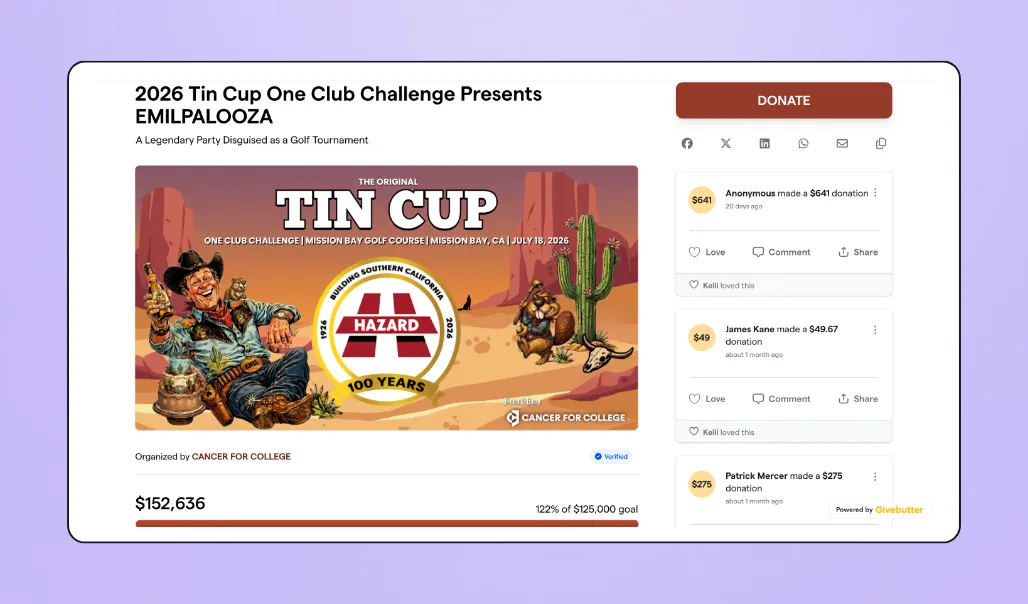
💸 Results: $151K+ raised from 118 donors—122% of its goal
💛 What nonprofits can borrow: A creative tournament concept that generates excitement and is easy to promote
3. Hubbard ISD Education Foundation Golf Tournament & Live Auction 🏫
The Hubbard ISD Education Foundation hosted a golf tournament and live auction to support scholarships, innovative teaching grants, and student achievement. Adding an auction created another way for attendees to contribute beyond registrations and sponsorships.
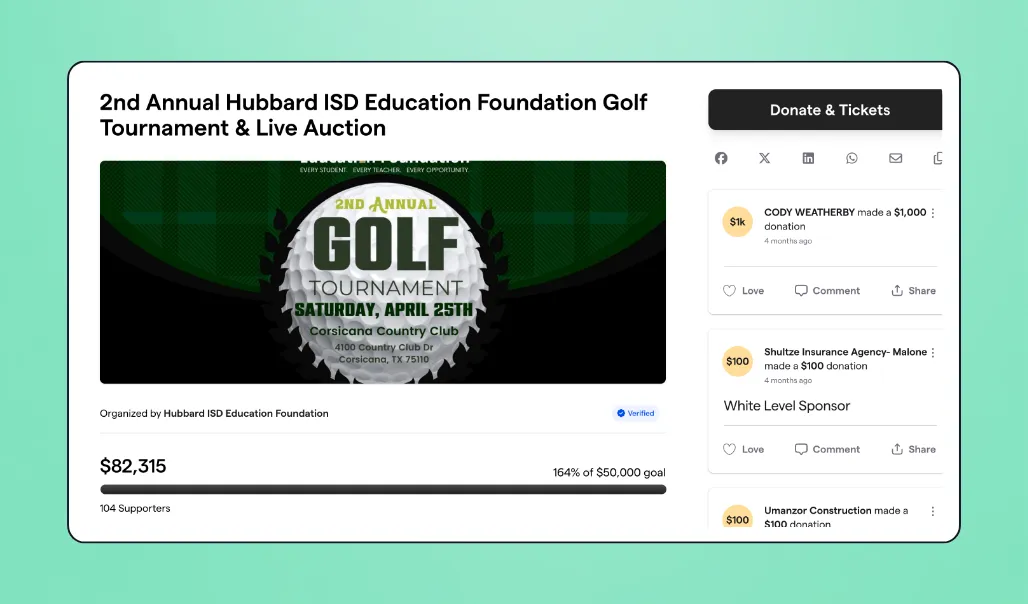
💸 Results: $74K+ raised from 99 donors—148% of its goal
💛 What nonprofits can borrow: Multiple revenue streams that give attendees more ways to participate and give
Run your charity golf tournament from one place
A successful golf fundraiser brings every revenue stream together—from player registrations and sponsorship packages to auctions, add-on purchases, and donations. Givebutter helps your team manage individual and foursome tickets, sponsor payments, auction bidding, mobile check-in, event-day giving, promotion, and post-event follow-up from one platform.
With fewer spreadsheets and disconnected tools to manage, your team can spend more time building relationships with golfers and sponsors—and creating an event they’ll want to support year after year.

Explore Givebutter’s nonprofit event management software
Create your free Givebutter account and start building your next charity golf tournament.
FAQs about planning a charity golf tournament
What is a charity golf tournament?
A charity golf tournament is an event where participants play golf while raising money for a nonprofit or specific cause. Revenue typically comes from player registration fees, corporate sponsorships, donations, and add-ons such as auctions, raffles, mulligans, and on-course contests.
How much can a charity golf tournament raise?
There’s no reliable average for how much a charity golf tournament can raise. Results depend on the number of players, registration prices, sponsorship revenue, add-on activities, and event expenses.
To estimate your net proceeds, subtract the course package, catering, prizes, marketing, and operational costs from the revenue generated through registrations, sponsorships, donations, auctions, and contests. Established tournaments with strong sponsor relationships can raise significantly more than first-time events.
How long does a charity golf tournament last?
Most charity golf tournaments are full-day events lasting approximately 6–8 hours. Plan for registration and breakfast, 4–5 hours of golf, and post-round activities such as an awards ceremony, auction, reception, or meal.
What is the best format for a golf tournament fundraiser?
Popular charity golf tournament formats include:
- Scramble: Every player hits a shot, the team selects the best one, and everyone plays their next shot from that location. The process continues until the hole is completed.
- Best Ball: Each golfer plays their own ball throughout the hole, and the team records its lowest individual score.
- Stroke Play: Each golfer plays every hole, and the player with the lowest total number of strokes wins.
A four-person scramble is usually the best format for a charity tournament because it welcomes golfers of different skill levels and helps maintain a steady pace of play.
How far in advance should you start planning a charity golf tournament?
Start planning 9–12 months before a first-time tournament and at least six months before an established event. Secure the golf course first, begin sponsor outreach four to six months out, and intensify participant marketing during the final 90 days.
Use our free charity golf tournament planning checklist to organize each stage.
How do you get sponsors for a charity golf tournament?
Start by approaching local businesses, existing corporate partners, vendors, and companies with a history of community involvement. Create tiered sponsorship packages with clear benefits, such as tee-box signage, recognition on event materials, social media promotion, contest naming rights, or a complimentary foursome.
Begin outreach four to six months before the tournament so sponsors have time to review the opportunity and include it in their budgets.
Share this article








.svg)
.svg)