












Most small teams nail the prompt thank-you after a gift. It’s what comes after (continued stewardship, recognition, and engagement) that they tend to struggle with.
That struggle makes sense. With a lean team, building strong donor relationships can feel like one more thing on an already full plate.
Below, you’ll learn what donor relations looks like for a small team, which strategies to prioritize, and how to measure progress.
Key takeaways
- Think of donor relations as an umbrella ☂️ Donor relations connects acknowledgment, stewardship, recognition, and engagement throughout the donor journey.
- Assign owners by gift tier 💸 On a small team, the executive director, development staff, and board each handle specific touchpoints.
- Keep one shared donor record 👥 Logging gifts, preferences, and relationship notes in a single CRM ensures that knowledge stays accessible, even when staff moves on.
- Personalize without overwhelming 👋 Use a welcome series, merge fields, and mostly non-ask updates to make donors feel valued, and match the level of personal outreach to each donor’s capacity and loyalty.
- Measure relationship health 📏 Track donor retention, first-time donor retention, and time to thank to see whether relationships are getting stronger.
What donor relations is & why it matters
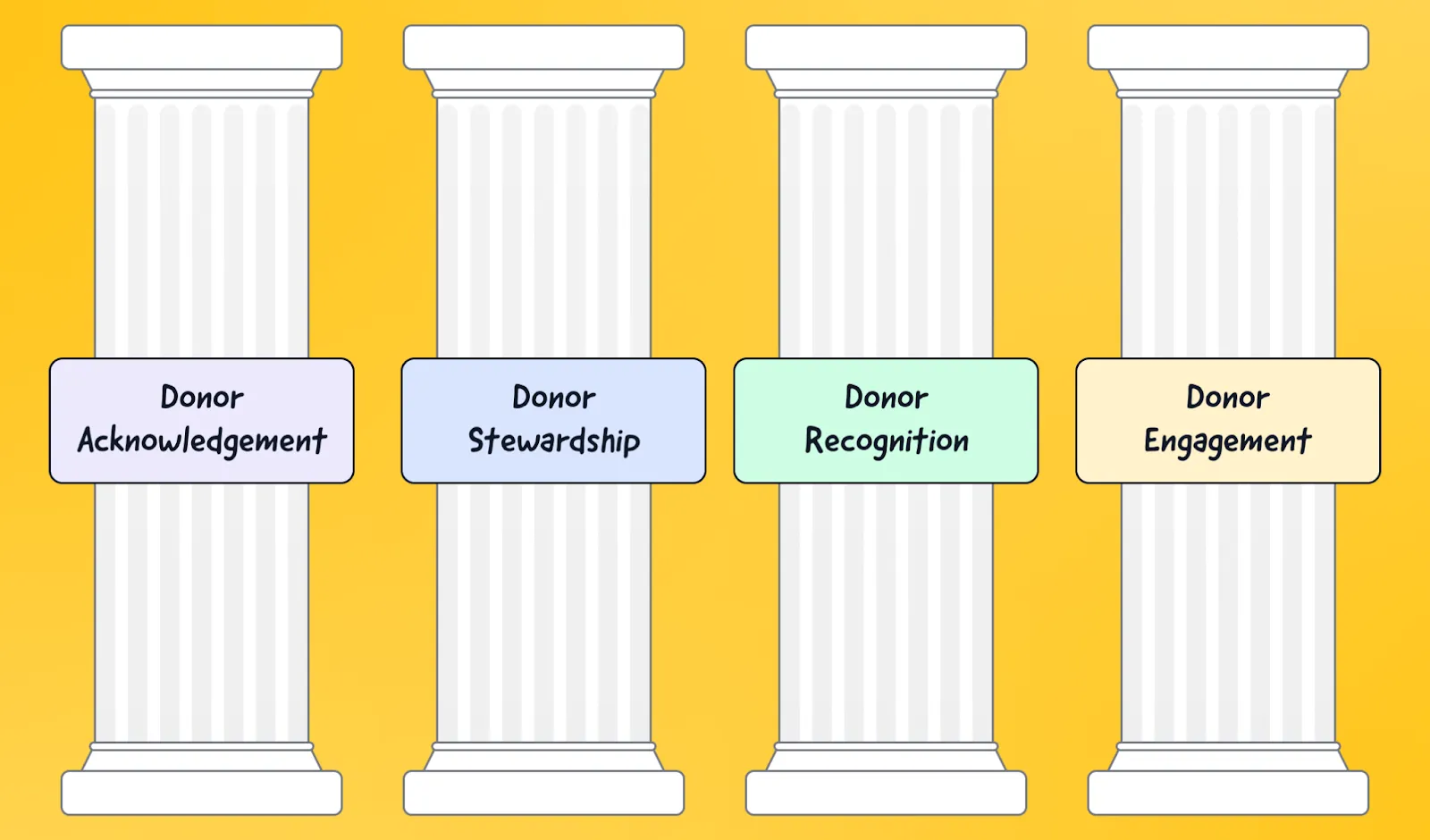
Donor relations, or donor relationship management, is the set of activities and strategies nonprofits use to build and maintain strong, long-term relationships with the people who give to them, from the first thank-you onward. It covers acknowledgment, stewardship, recognition, and engagement across every gift size.
Fostering relationships with donors is essential for maintaining your organization’s financial stability. Engaged donors are far more likely to give again, helping nonprofits cover operational costs, fund new initiatives, and better serve their communities.
The 4 pillars of donor relations
One of the easiest ways to improve donor relations is to follow the four-pillar approach. This framework from the Donor Relations Group encourages nonprofits to consider different stages, or pillars, as they plan their donor engagement activities:
Who owns donor relations at your nonprofit?
At larger nonprofits, donor relations is often handled by a dedicated staff member or team. At a small nonprofit, it’s a shared responsibility, with the executive director, development staff, and board each owning specific touchpoints.
If you’re operating with a small staff, use the example tiers below as a starting point and set gift thresholds that fit your own donor base:
If you have the budget, consider hiring a dedicated donor relations specialist to manage the entire donor-mission relationship.
When you’re hiring, look for the following qualities:
- Curiosity: Your donor relations expert should be driven to analyze donor data and giving patterns to understand what motivates supporters and how you can encourage giving.
- Enthusiasm: An effective donor relations manager spends a lot of time interacting with your supporters, so they should be passionate about your mission and building relationships.
- Organization: Managing donor relations involves many challenges and moving pieces, so an eye for organization is a must.
How to build a donor relations strategy in 3 steps
Even small organizations can invest in their donor relations strategy and see a huge impact.
To improve your overall donor experience, consider introducing the following tactics.
1. Write (or refresh) your donor relations plan 📝
Craft a solid donor relations plan or review your existing one to work more effectively. Be sure to include:
- Goal: Decide what your overall goal is (e.g., increase donor engagement by a percentage) and how you’ll measure it over time.
- Budget: Assign a realistic budget to help your team stay on track and make smarter financial decisions.
- Donor relations activities: List all the activities you’ll use to build and maintain donor relationships.
- Owners: Name who’s responsible for each donor tier, using the ownership table above as a guide.
- Cadence: Set how often each tier hears from you, such as a personal call within a few days for larger first gifts or quarterly updates for recurring donors.
💡 Pro tip: Use Givebutter Plus’s task management feature to help your team stay on top of your donor relations to-do list.
2. Build a complete picture of every donor 🔍
Storing data in a donor database or nonprofit CRM keeps all interactions in one place. Emails and texts sent through your CRM are logged automatically, and you can add phone calls, meetings, and notes to each donor’s record. Plus, you can store contact information, past event attendance, and giving history.
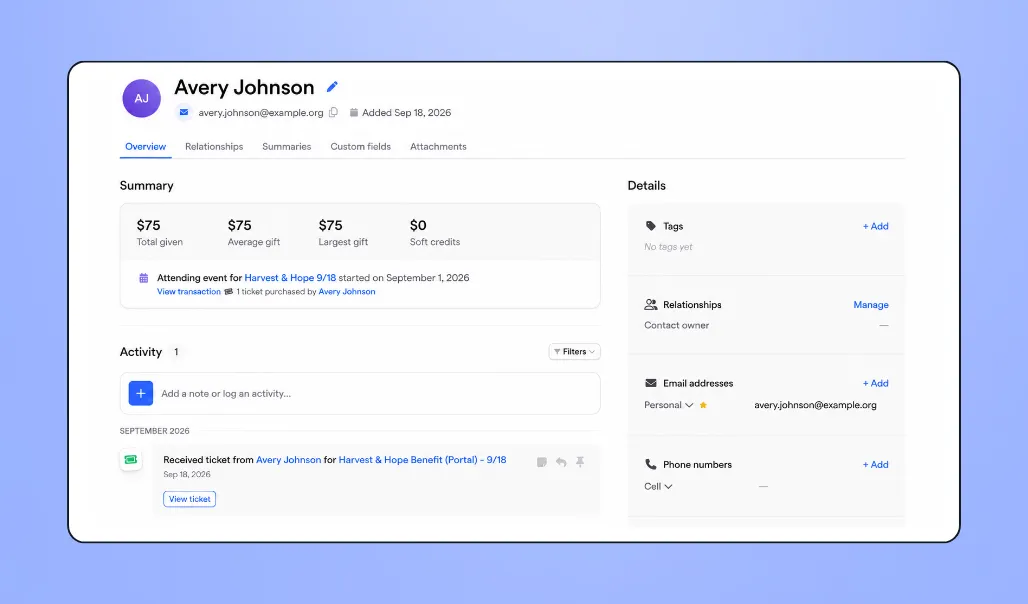
Over time, you’ll establish a complete donor profile, so you can send more personalized communications and not have to worry about losing it with staff turnover.
Once you have your donor management system set up, be sure to:
- Create personas: Identify patterns to guide your marketing strategy for your target audience.
- Segment your donors: Use donor segmentation to personalize your communications to individual groups.
- Collect interests and insights: Use custom fields, tags, or notes to store additional insights about your donors, so you can send thoughtful, relevant messages.
💡 Pro tip: With Givebutter, you can see every donor’s giving summary, upcoming event tickets, and communication preferences, plus a filterable activity feed at the top of each record.

3. Personalize every touchpoint, starting with a welcome series ✉️
Many first-time donors know very little about your organization when they make their contribution. To keep them engaged, move them into an automated email sequence to help them learn more about who you are and what you do.
A sample welcome series may look like this:
- First email: A custom message thanking the individual for their contribution and offering a quick overview of your mission. This email should arrive in your supporter’s inbox on the day they donate.
- Second email: A breakdown of how individual donations are spent and their impact. This email should arrive 2–5 days after the first email.
- Third email: A quick overview of ways to get involved, including upcoming events, opportunities, and programs. This email should arrive 2–5 days after the second email.
💡 Pro tip: Set up a workflow in Givebutter Plus to automatically send your new donors a welcome sequence.
After the welcome series, ensure that every touchpoint is personal:
- Add your donor’s name: Use merge fields to automatically add your donor’s name to emails and other messages.
- Highlight their contribution: Mention how much they recently donated or share an update on a specific project they helped fund.
- Use the right software: Choose a CRM like Givebutter that integrates with your fundraising and marketing software, so you can use donor data to personalize outreach.
Donor relations best practices that deepen loyalty
Follow these best practices to strengthen your donor relationships:
- Optimize the donor experience ✨ Always look for opportunities to make your donor experience smoother, more personal, and more enjoyable. With Givebutter’s free donor portal, supporters can access their own giving history, receipts, event tickets, and recurring gifts.
- Send a welcome package 🎁 Mail a welcome package to new major donors, featuring the story of your organization, a handwritten thank-you card, and a small gift.
- Create a video montage 🎬 Showcase beneficiary photos in a video montage at your next event.
- Invite donors in person 🎉 Host an open house at your headquarters with a tour and a happy hour, or celebrate supporters with a behind-the-scenes night or a casual meet-and-greet.
- Reward loyalty & get creative with recognition 🏆 Start a loyalty program with perks, exclusive merch, or other benefits, and publicize supporters’ involvement by adding names to a virtual wall or creating a giving society.
- Ask for feedback & share what you learn 💬 Survey supporters about future activities and record their preferences in their donor record. Then communicate openly about your activities and impact to build trust.
How to measure the health of your donor relationships
Retention is one of the clearest signs that your donor relations strategy is working, yet many nonprofits aren’t tracking it. In a Givebutter survey of 16 nonprofit leaders, nearly half said they don’t monitor their donor retention rate.
Industry benchmarks can offer helpful context. According to M+R Benchmarks 2026, new online donor retention was 24%, and 71% of monthly supporters remained active a year after their first gift.
But every nonprofit’s donor base is different, so industry benchmarks only tell part of the story. Find your own baseline, then set realistic targets to improve it year over year.
The metrics below give you a simple way to check in on relationship health:
The thank-you is just the beginning
Most small teams already know how to say thank you. The right donor relations strategy goes beyond that, ensuring first-time donors become loyal, long-term supporters.
You don’t have to overhaul everything at once. Pick one gap to close this month: assign a clear owner for thank-yous, set up a welcome series for new donors, or choose one relationship metric to check each quarter. Small, consistent steps add up to donors who stick around.
With monthly giving tools and easy engagement features like email and mailings, and a powerful CRM, Givebutter brings together everything you need to grow relationships and ensure no donors fall through the cracks.

Build stronger donor relationships in one place
Sign up for your free Givebutter account today to start strengthening your relationships.
FAQs about donor relations
What is the donor relations process?
The donor relations process covers the activities nonprofits use to build and maintain relationships with donors. These include acknowledging gifts, stewarding donors, recognizing their support, and keeping them engaged. Nonprofits then measure the success of these efforts.
What does a donor relations officer do?
A donor relations officer ensures donors feel thanked, informed, and valued after they give. Typical duties include managing gift acknowledgments, sending stewardship and impact reports, running recognition programs and donor events, and maintaining accurate donor records.
However, their specific responsibilities can vary based on their title. A director of donor relations may oversee a major donor strategy, while a donor relations coordinator handles day-to-day programming, like running LYBUNT and SYBUNT reports for analysis.
What’s the difference between donor relations & donor stewardship?
Donor stewardship is one part of donor relations (showing donors the impact of their gift), while donor relations covers the whole relationship, connecting acknowledgment, stewardship, recognition, and engagement.
Share this article