.svg)
.svg)
.svg)
.svg)
.svg)
.svg)
.svg)
.svg)
.svg)


.svg)
.svg)
.svg)
.svg)
.svg)
.svg)
.svg)
.svg)

.svg)
.svg)
.svg)

.svg)

.svg)
.svg)
.svg)
.svg)
.svg)


.svg)
.svg)
.svg)
.svg)
.svg)
.svg)
.svg)





.svg)




%20(1).png)

When should you ask for donations? How often is too often? And how do you plan a full year of fundraising without exhausting your team or your donors?
Without a clear plan, it's easy to fall into reactive fundraising. Campaigns feel rushed, opportunities get missed, and your team is constantly playing catch-up.
A fundraising calendar brings structure to the chaos. In this guide, you'll learn how to map out your year with the right timing, the right mix of campaigns, and the right strategy. We'll cover the seven key sections to include, the most important dates to plan around, and four simple steps to build your own calendar.
You can also grab a free template to get started right away.
Key takeaways
- Plan your calendar around donor psychology, not just logistics 🧠 Timing campaigns to align with peak giving seasons dramatically increases your chances of hitting fundraising goals.
- Include core sections 🗂️ Donor groups, goals, fundraising activities, communication plans, team responsibilities, income/expenses, and key dates give your calendar real strategic structure.
- Build your calendar in four steps 🗓️ Set SMART goals, choose fundraising methods, place campaigns strategically on the calendar, then review and adjust regularly.
- Run your calendar on Givebutter 🧈 With fundraising campaigns, donation forms, event tools, and donor management all in one platform, Givebutter gives your team everything it needs to execute from start to finish.
Download your free nonprofit fundraising calendar template
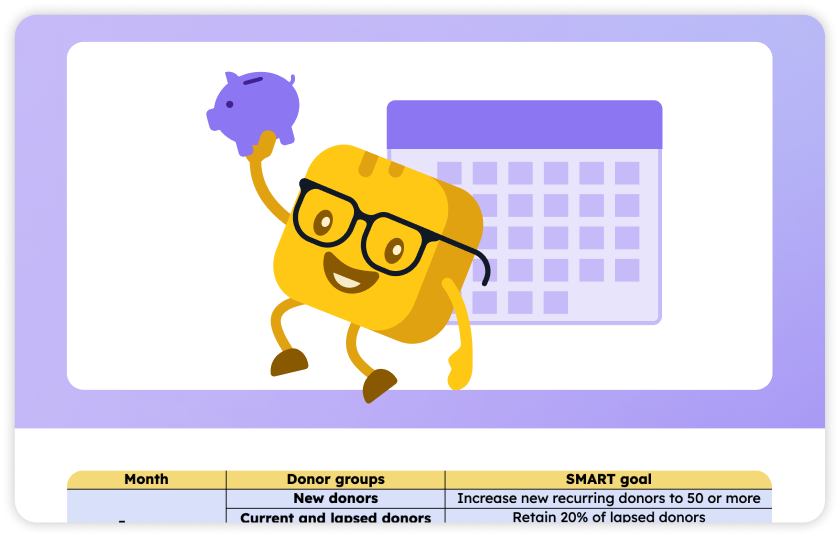
This fundraising calendar template provides a foundation for planning next year's fundraising efforts. Read on below to learn how to fill it out, from determining budget allocations to mapping out the communication plan month by month.
What to include in your fundraising calendar
Using your annual fundraising plan as your foundation, you can build a fundraising calendar that maps exactly how you'll implement your strategy throughout the year.
The layout of your fundraising calendar is crucial. Divide it into months or quarters, whichever works best for your organization based on key dates and fundraising goals. Then, integrate the following seven elements from your fundraising plan into it.
1. Donor groups 👫
Your annual fundraising plan focuses on three primary goals:
- Increasing new donors 👋
- Retaining current and lapsed donors 🔃
- Upgrading experiences for all donors 📈
Your organization should add goals, fundraising activities, and donor stewardship strategies for each group across each month or quarter.
2. SMART goals 🤓
After you set specific, measurable, achievable, results-oriented, and time-bound (SMART) fundraising goals for each donor segment, the question becomes: How will you reach your goals? Incorporating these specific benchmarks into your calendar will keep you on track and increase your chances of success.

3. Fundraising activities 🎩
Fundraising activities include recurring donor campaigns, peer-to-peer fundraising, donor surveys, and major donor outreach. Adding this section to your calendar lays the foundation for your communication plans and helps you determine how far in advance to schedule these activities.
⭐️ Here's a simple fundraising calendar example: A mid-size nonprofit might schedule a peer-to-peer campaign in the spring, a summer appeal for lapsed donors, a GivingTuesday push in November, and a year-end giving campaign in December—each with its own communication plan, team owner, and budget line.
4. Donor communication plans ☎️
Your supporters don't want to be treated like ATMs. Build intentional donor communication steps into your calendar, including surveys, acknowledgment letters, and thank-you calls.
For example, one of your goals is to increase recurring donor funds this year, so your calendar includes a recurring donor appeal. Under your communication plan, you'll add steps such as:
- Develop membership benefits 💬
- Create a recurring donor landing page 🔁
- Launch an online campaign 📲
- Send emails ✍️
- Post on social media 💥
5. Team member roles & responsibilities 🙋
Decide who owns each of your fundraising activities and donor communications. This includes board members, staff, volunteers, vendors, sponsors, and more.
A RACI framework (responsible, accountable, consulted, and informed) helps ensure everyone knows their role and stays organized.
6. Expenses & income 💸
Your annual fundraising plan outlines expected income and expenses for each event and campaign. Still, your fundraising calendar can break these numbers down to show when funds will actually flow in and out of your bank account.
For instance, if your annual gala is scheduled a few months into the year but funds are limited beforehand, prioritize securing sponsorships early.
7. Key dates & deadlines ⌛
Once you add specific fundraising activities to your calendar, you must also start adding specific dates like:
- Major holidays 🧑🎄
- Event dates 📅
- Grant deadlines ✍️
- Annual report deadlines 📃
- Days when your office is closed 🌴
You'll also want to account for key fundraising dates and seasons.
Important fundraising dates to know
Not sure which dates to include in your calendar? Here are the most important fundraising days and seasons to be aware of.
GivingTuesday 💙
GivingTuesday is the Super Bowl of nonprofit fundraising. Held annually on the first Tuesday after Thanksgiving, it's a global generosity movement that drives millions of donors to give in a single 24-hour period.
Over 38 million people participated in GivingTuesday last year, donating $4B in the U.S. alone.
Year-end giving season 🗓️
GivingTuesday kicks off the most important fundraising stretch of the year, with nearly 30% of all annual giving happening in December.
This surge is driven by tax deadlines, holiday generosity, and year-end reflection, making it a critical window to plan for in your fundraising calendar.
Other giving days worth marking 🎁
GivingTuesday and year-end aren't the only dates to map out. Here are a few other key moments that tend to put donors in the giving mood:
- February 14: Valentine's Day
- March 8: International Women's Day
- April 22: Earth Day
- May: Mental Health Awareness Month
- June: Pride Month
- August/September: Back-to-school giving
- October: Breast Cancer Awareness Month and Domestic Violence Awareness Month
- November 11: Veterans Day
💡 Looking for campaign inspiration to match these dates? Explore Givebutter's fundraising ideas for strategies you can build around every season.
How to create a fundraising calendar in 4 steps
Now that you know what your fundraising calendar should include and which dates to plan around, here's how to build your own step-by-step.
Step 1: Set goals & objectives 🎯
Think of your fundraising calendar like planning a road trip—you need to know your destination before mapping the route.
To set goals, follow these steps:
- Review last year's figures: Look at total amount raised, number of donors, and donor retention rate to establish a realistic baseline for growth.
- Define your needs: Account for funding required to support program costs, operational expenses, emergency funds, and growth initiatives.
- Assess your capacity: Be realistic about available staff time, volunteer support, resources, and budget.
And be sure some of those goals are non-financial, too (e.g., donor acquisition, community awareness).
Step 2: Choose your fundraising methods 💸
With your goals in mind, choose the fundraising methods that will help you reach them. Popular options include:
- Peer-to-peer fundraising
- Special events
- Monthly and annual giving campaigns
- Grants
- Corporate partnerships
- Capital campaigns
- Planned giving campaigns
- Crowdfunding campaigns
Step 3: Set dates & times 🕜
Once you've determined what kind of campaigns you'd like to use throughout the year, it's time to place them on the calendar:
- Begin with fixed dates: Mark non-negotiable dates like GivingTuesday, your fiscal year dates, grant deadlines, and any fixed commitments.
- Schedule major events: Spread your largest, most resource-intensive activities (like galas, walks, or auctions) strategically throughout the year.
- Layer in campaigns: Center your core fundraising activities like annual appeals and digital campaigns around your major events, ensuring they don't compete for attention or resources.
- Build in buffer: Create a margin between campaigns to prevent donor fatigue, allow for staff recovery, and maintain flexibility for unexpected opportunities or emergency appeals.
- Map communications: Schedule your donor communications, including thank-you messages, newsletters, impact reports, and stewardship touches to maintain engagement.
Step 4: Evaluate & repeat 🔃
Regular monitoring and adjustments ensure your calendar stays an effective fundraising tool:
- Create regular check-in points: Mark consistent review times, like weekly progress checks and monthly campaign assessments, directly in your calendar.
- Make adjustments: Shift campaign dates, reallocate resources, or modify outreach methods based on progress.
- Build for the future: Use your year-end evaluation to create a template for next year's calendar.
Put your fundraising calendar into action with Givebutter
A strong fundraising calendar gives you more than a plan. It helps prioritize campaigns, time your asks more effectively, and keep your team aligned all year. With the right structure in place, you can move from reactive fundraising to a strategy that builds momentum over time.
With Givebutter, you can bring every part of your fundraising plan to life. Launch donation forms, create fundraising pages, host events and auctions, and track donor activity—all in one place. Instead of juggling multiple tools, your team can execute your strategy seamlessly and stay focused on what matters most: strengthening relationships and raising more.
.png)
Create your first fundraising page in minutes
Sign up for Givebutter for free and start building your best fundraising year yet.
FAQs about nonprofit fundraising calendars
What is a fundraising calendar?
A fundraising calendar is your nonprofit's master planning document that maps out fundraising activities, campaigns, and donor communications throughout the year. Think of it as your strategic plan in calendar form, coordinating everything from major events and grant deadlines to donor outreach and stewardship.
Why does my nonprofit need a fundraising calendar?
A fundraising calendar helps prevent reactive, last-minute fundraising by creating a structured approach to revenue generation and donor engagement. It helps distribute activities evenly throughout the calendar year, prevents donor fatigue, and ensures your team has adequate preparation time for each fundraising campaign.
When should I create a fundraising calendar?
The ideal time to create your annual fundraising calendar is 2–3 months before your fiscal year begins, allowing enough time for thoughtful planning and team input. This ensures you can launch your fiscal year with a clear strategy while incorporating lessons learned from your current year's activities.
How often should I update my fundraising calendar?
Review your fundraising calendar monthly for minor adjustments, and schedule formal quarterly reviews to assess performance, make strategic adjustments, and accommodate new opportunities or challenges.
What should a monthly fundraising calendar include?
Your monthly fundraising calendar should include donor groups, SMART goals, fundraising activities, donor communication plans, team member roles and responsibilities, income and expenses, and key dates and deadlines.
Share this article








.svg)
.svg)