.svg)
.svg)
.svg)
.svg)
.svg)
.svg)
.svg)
.svg)
.svg)


.svg)
.svg)
.svg)
.svg)
.svg)
.svg)
.svg)
.svg)

.svg)
.svg)
.svg)

.svg)

.svg)
.svg)
.svg)
.svg)
.svg)


.svg)
.svg)
.svg)
.svg)
.svg)
.svg)
.svg)




.svg)




%20(1).png)

Grants represent one of the most powerful ways to fund your nonprofit’s mission, but knowing how to write a grant proposal that actually wins funding is a skill that takes time to develop.
The tricky part isn’t the writing itself. It’s knowing what funders actually want to see, navigating formats that change with every application, and finding the time to do it all while running programs and managing a team.
This post breaks down how to write a grant proposal in 9 clear steps, with real examples for the sections funders scrutinize most. Whether you’re writing your first proposal or your fiftieth, you’ll walk away with a structure that works and a free template to make the process faster every time.
Key takeaways
- Lead with measurable outcomes 📊 Funders care most about evaluation and data. Prioritize those!
- Start with research, not writing 🔍 Many proposals are rejected because of mismatches in funder priorities. Before anything else, find funders who already support your issue area.
- Treat the LOI like a first impression 💌 A relationship-first approach wins more grants than cold submissions.
- Build a swipe file 📁 Reusing 70–80% of your last successful proposal is smart. Keep a running doc of your strongest needs statements, impact stories, and budget narratives.
- Tie the budget to outcomes 💰 Funders often decline proposals because the impact, budget, and program plan don’t align.
- Track your impact in one place 💛 Givebutter’s nonprofit CRM helps you pull board-ready reports, segment donors, and demonstrate impact so when it’s time to apply, your numbers are ready.
What is a grant proposal?
A grant proposal is a formal written request to a foundation, government agency, or corporate funder asking for financial support for a specific nonprofit project or program. It outlines the need, your plan to address it, the budget, and how you’ll measure success.
Depending on the funder’s application process, your proposal may also include a letter of inquiry or a grant report. A letter of inquiry (LOI) is a short pitch sent before the full grant application, while a grant report is a post-funding document that shows how you used the funds you have received.
How to write a grant proposal for nonprofit organizations: 9 steps to follow
Grant funding is competitive. In a 2024 Candid analysis of nearly 4,000 nonprofits, foundation and nonprofit grants ranked as the second most common revenue source, meaning a lot of organizations are competing for the same dollars.
A compelling proposal won’t just tell funders what you do. It will show them exactly why your organization is the right recipient for their money. Here’s how to do it in 9 steps.
💡 Keep in mind: Always refer to the funder’s application guidelines before you start. Requirements vary and override everything below.
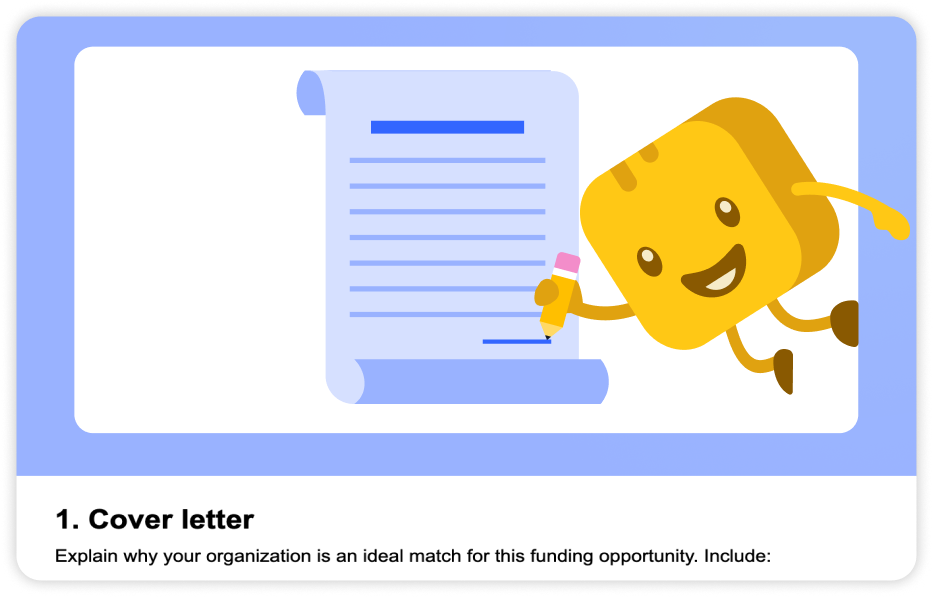
1. Write a succinct cover letter ✔️
The cover letter should open by addressing the funder’s question: Why should we fund you over the next applicant?
Explain who you are, the amount of funds you’re requesting, and why. This is your first chance to signal to the funding organization that you’re an ideal match and make them eager to keep reading.
2. State your case 📣
Next, you’ll want to help funders understand: Can this organization actually deliver?
Lead with proof of impact (numbers served, programs run, year founded) and key details like introducing your executive director, board members, or other stakeholders.
3. Write your statement of need 📄
After introducing your organization, it’s time to explain why you’re seeking funding. That means answering the question: Why does this problem need solving, and why now?
Clearly define the population you serve, the challenge they’re facing, and the measurable outcome your program will achieve, backed by 1–2 cited stats. The funder should feel the problem before they meet your solution.
⭐ Example statement of need (excerpt): “In Maricopa County, 1 in 5 children aged 5–12 lacks consistent after-school care while a parent works late shifts. Our 2025 needs assessment of 312 families found that 78% had been turned away from existing programs due to capacity. [Org] proposes to serve 200 of those families…”
💡 Pro tip: Some grant writers recommend leading with external data, like community statistics, research, and local reports, before introducing your organization’s role.

4. Build your evaluation plan 📊
The funding organization doesn’t just want to know how you’ll use the money. They want to understand: How will we know this worked?
Define how you’ll measure success: the specific outcomes you’ll track, the metrics that prove impact, and the timeline for reporting back to the funder. The more concrete your measurement plan, the more confident the funder will feel investing in your work.
⭐ Example: “We’ll track the attendance of the 200 families enrolled in our after-school program as well as administer caregiver surveys each semester to measure attitudes and levels of stress surrounding our program. Our program director, [Name], will compile results into a mid-year and final report submitted to the funder in both January and June 2026.”
💡 Pro tip: Think like an auditor, not a storyteller here. Name the specific data you’ll collect (e.g., pre/post surveys, attendance records, third-party assessments), who’s responsible for collecting it, and when you’ll report results.
5. Introduce your project plan 💼
A key part of the nonprofit grant writing process involves helping potential funders answer this question: What exactly will you do with our money?
Prepare a project plan that assures the funding organization that you can deliver. Write from the perspective that the funding is secured, and outline exactly which activities or programs you’ll fund. Include project milestones, proposed launch dates, staff members, resources, and outcomes.
💡 Pro tip: When a funder’s guidelines don’t specify a format, default to the language and priorities used on the funder’s website or in past RFPs. Mirroring their structure signals alignment and makes the reviewer’s job easier.
6. Create a proposed project budget ⚖️
Your budget should answer a simple question: Does every dollar tie to a real deliverable?
Calculate your project expenses, including materials, office or venue costs, staff and consultant pay, and overhead.
Ensure every line item connects directly to a specific program activity and double-check that every expense in your budget appears in your program narrative. Funders cross-reference the two; a line item with no narrative context is a fast path to a follow-up question or a rejection.
⭐ Example budget narrative (excerpt): Program coordinator salary ($44K); handles management of daily operations and all family intake. Curriculum materials ($6.5K); workbooks and literacy kits distributed at program launch.
💡 Pro tip: A strong, clear budget signals to funders that you don’t just have an urgent need for funding, but you also know how to make a practical, lasting impact. Combine data with storytelling to illustrate why you’re the ideal grant recipient.
7. Look ahead for long-term stability 🌲
An effective grant proposal shows how the funds will support your mission in the short term and provide stability over the long term, answering the question: What happens when our check runs out?
Explain how you’ll use these funds not just as a temporary solution but to further your mission and create lasting change. Investing in long-term capacity and program growth shows funders that you’re thinking beyond the immediate grant period.
8. Summarize your proposal 📝
Write this section last, even though it appears first in your final submission. Once you’ve drafted the core components of your proposal, write an executive summary that answers: What are you asking for and why does it matter?
This section highlights the key points of your proposal and serves as a roadmap for the reader. If required or if your proposal is long, include a table of contents to help the funder find the information they need.
9. Review your proposal ✏️
Finally, take your grant proposal through a full review process before you submit it, asking: Would a stranger outside your nonprofit understand this?
This isn’t just about catching typos, but jargon and assumed knowledge. Terms like “riparian buffer restoration” or “trauma-informed wraparound services” might be obvious inside your org but opaque to a funder. If your reviewer asks what something means, rewrite it.
Send your grant proposal to team members, an external editor, or a consultant for review. Ask them to identify any mistakes and suggest ways to strengthen your proposal.
Once you’ve incorporated their feedback, give your proposal one final read-through. You’re now ready to submit! 🎉
Download your free grant proposal template
Don’t start from scratch every time you need to submit a grant proposal.
Use this sample grant proposal template, which includes all the essential sections, along with tips to help you craft a winning grant proposal for your nonprofit.
Grant writing best practices that win more funders
Great grant writing for nonprofits goes beyond filling in the right sections. The proposals that win tend to follow a few key practices before, during, and after the writing itself.
Here’s what experienced grant writers consistently get right.
Before you write 🔍
- Build a relationship: Stay active in communication with funders, balancing visibility with respect for their time. A relationship-first approach can win more grants than cold submissions. Before writing a word, find out if the funder already supports your issue area and whether you have any existing connections to them.
- Calibrate your expectations: A 20% success rate is considered solid in grant writing. Most funders approve only about 1 in 10 applications. Rejection is part of the process, not a signal to stop.
- Steal the funder’s language: Check out the funder’s last five grant announcements and mirror their priorities and phrases in your proposal.
- Focus on the right opportunities: Apply for grants that are the closest match first, so you can focus your energy on writing one successful application rather than a handful of less impressive ones.
- Build a swipe file: Keep a master document with your strongest needs statements, program descriptions, outcome metrics, staff bios, and organizational background. When a new opportunity comes, adapt those materials to fit the funder’s format and requirements.
While you write 📝
- Follow application instructions carefully: Treat all instructions as requirements and avoid deviating from them. If anything is unclear, reach out to the funder for clarification.
- Show why you’re the organization for this task: Demonstrate how you’re uniquely positioned to address the need through your programs, partnerships, or track record.
- Focus on your mission, values, and goals: It can be tempting to apply for every available opportunity, but the strongest proposals come from genuine alignment between your mission and the funder’s priorities.
- Make your proposal reader-friendly: Structure your grant proposal for readability with skimmable content, short sentences, and plenty of white space.
- Review grant proposal examples for nonprofits: Study grant writing examples to compare the structure, storytelling, and impact to your own, and consider where you can make improvements.
Before you submit 📬
- Align your proposal with the funder’s priorities: Review the grant documents to understand how applications are scored and what the funder cares most about, so you can submit a highly relevant application.
- Get a peer review: Send your finished proposal to trusted colleagues or a grant consultant and ask them to flag anything that is missing or unclear.

Start writing your best grant proposal yet
Grant writing is one of the highest-leverage things a small nonprofit team can do, and the organizations that win consistently aren’t always the ones with the best programs. They’re the ones with the clearest proposals, the strongest funder relationships, and the systems to back up their impact claims.
Managing donors, fundraising campaigns, and reporting shouldn’t pull your team away from pursuing new funding opportunities. Givebutter helps nonprofits centralize fundraising activities with donor management, donor segments, board-ready reports, fundraising pages, auctions, and events, so your team can spend less time managing systems and focus on growing your mission.

Get organized with Givebutter's free nonprofit CRM
Sign up for free today and discover how Givebutter can help your nonprofit build a more sustainable future.
FAQs about grant writing for nonprofits
How do I write a grant proposal for the first time?
To write a grant proposal for the first time, start with funder research before writing anything. Find funders who already support your issue area, read their guidelines carefully, and reach out with a letter of inquiry if they accept them.
Then build out each section using a reusable template, including your cover letter, statement of need, evaluation plan, budget, and sustainability plan. The free grant proposal template above gives you the full structure, so you’re not starting from scratch.
How long does it take to write a grant proposal?
Writing a grant proposal typically takes 10 to 30 hours for a first-time submission, depending on the funder’s requirements and the amount of research involved.
Subsequent proposals using a reusable template can take significantly less time. The more organized your supporting materials are, including program descriptions, outcome data, and staff bios, the faster the process gets.
How long should a grant proposal be?
A grant proposal should be as long as the funder requires, no more and no less. Most foundation proposals run 5 to 10 pages. Federal grants can require 20 or more pages of narrative plus attachments. Letters of inquiry are typically 1 to 2 pages and serve as a pre-proposal pitch before a full submission is requested.
What is the difference between an LOI and a grant proposal?
A letter of inquiry (LOI) is a 1 to 2-page pitch sent before the full proposal to gauge whether a funder is interested in your work.
A full grant proposal is the complete funding request, typically 5 to 20 pages, covering your needs statement, program plan, budget, evaluation plan, and organizational background. Most funders use the LOI to screen applicants before inviting a full submission.
Is it okay to reuse content from previous grant applications?
Yes, reusing content from previous grant applications is standard practice in nonprofit grant writing. Mission statements, organizational history, program descriptions, and outcome data can all be carried over and adapted for new applications.
Build a reusable swipe file of your strongest sections so every new application starts from a strong foundation rather than a blank page. The key is tailoring each section to the specific funder’s priorities and requirements rather than submitting the same proposal verbatim.
What are the 5 R’s of grant writing?
The 5 R’s of grant writing are readiness, research, relationships, writing, and reporting. They represent the five stages of a successful grant process: assessing whether your org is ready to apply, researching the right funders, building relationships before submitting, writing a compelling proposal, and reporting outcomes to the funder after the grant is awarded.
Share this article


.webp)





.svg)
.svg)