.svg)
.svg)
.svg)
.svg)
.svg)
.svg)
.svg)
.svg)
.svg)


.svg)
.svg)
.svg)
.svg)
.svg)
.svg)
.svg)
.svg)

.svg)
.svg)
.svg)

.svg)

.svg)
.svg)
.svg)
.svg)
.svg)


.svg)
.svg)
.svg)
.svg)
.svg)
.svg)
.svg)





.svg)


.webp)
%20(1).png)

You won the grant—take a moment to celebrate! But once the award letter arrives, that excitement can quickly give way to a new set of questions: How will you track every dollar, keep up with reporting deadlines, and make sure nothing slips through the cracks? For a small nonprofit team already wearing a dozen hats, post-award grant management can feel like a lot.
Luckily, you don’t need a dedicated grants department or an expensive system to stay organized. In this guide, we’ll walk through a practical nonprofit grant management process, from tracking restricted funds and coordinating with program staff to meeting funder requirements and choosing tools that fit your capacity. Plus, you’ll get a free grant management tracker to help you manage every award with confidence.
Key takeaways
- Think of winning the grant as the starting line 🏃 True nonprofit grant management goes beyond application and award. Tracking, reporting, and closeout are all equally important.
- Track restricted grants separately 🔎 Use a distinct grant code, class, project, or subaccount so your records clearly show how restricted funds were used.
- Eliminate reporting bottlenecks 📊 Getting program teams to submit impact data before deadlines is a big hurdle. Standardized forms and scheduled quarterly check-ins can help.
- Don’t forget documentation 📁 Keep receipts, invoices, contracts, payroll records, and any personnel-cost documentation required by the award.
- Choose simple over sophisticated 💪 A consistently used system for nonprofit grant management beats clunky software every time.
- Support grant management with Givebutter 🧈 Organize funder contacts and grant payments, then use Givebutter Plus for QuickBooks sync and reporting.
What is grant management?
Nonprofit grant management is the complete process of applying for, receiving, tracking, reporting on, and closing out a grant. It spans every phase, from the initial application to the final financial reconciliation.
Grant management involves project coordination, restricted fund tracking, compliance, data collection, funder communication, and reporting. Managing each piece well helps your nonprofit stay accountable, build trust with funders, and strengthen its chances of receiving future funding.

The grant management lifecycle: Before & after the award
The grant management lifecycle begins long before funding arrives and continues through final reporting and closeout. While many guides focus on finding grants and submitting proposals, this article centers on what happens after you receive an award.

Post-award grant management: 5 steps to stay on track
Post-award management is part project management, part financial tracking, and part relationship management. It runs from the day the award letter arrives until the grant closes out. Here are five practical steps for doing it successfully.
Step 1: Set up restricted fund tracking on day one 🏦
Start by reviewing the award letter and approved budget for spending restrictions, grant dates, reporting requirements, and allowable expenses. If the funding is restricted, use a separate grant code, class, project, or subaccount to track its revenue and expenses.
You may not need a separate bank account unless the grant agreement requires one, but your records should clearly show how every restricted dollar was used. Most nonprofits rely on one of these grant management tools:
- Spreadsheets: For a small grant portfolio, a spreadsheet with columns for the expense date, amount, vendor, purpose, grant code, and supporting documentation may be enough.
- Fund accounting software: A dedicated platform can help organizations managing several grants, funding sources, or complex expense allocations.
- QuickBooks Online: Use classes or subaccounts to organize transactions by grant and generate reports showing how funds were spent. Givebutter Plus can sync transaction data to QuickBooks Online, reducing manual data entry.
Step 2: Mark every deadline in your calendar 🗓️
Post-award grant management comes with more dates than just the final report deadline. Add spending deadlines, program milestones, financial reports, progress reports, and renewal windows to a shared calendar as soon as the award letter arrives.
- Create a shared calendar: Keep every grant deadline visible to the people responsible for meeting it.
- Assign roles: Give each task a clear owner so everyone knows who is responsible for financial data, program results, and funder communication.
- Set reminders: Schedule reminders four weeks and two weeks before each deadline, leaving time to collect information and review the report.
Step 3: Build a grant tracking system 📊
A grant tracking system keeps your portfolio organized and gives your team a single source of truth. It doesn’t need to be sophisticated, but it should include:
- Funder name and contact information
- Award amount
- Grant period
- Purpose and spending restrictions
- Payment and spending deadlines
- Reporting requirements and due dates
- Current status
- Assigned owner
💡 Pro tip: If a spreadsheet feels too static, Airtable’s Kanban view can help your team see what’s due, in progress, and overdue at a glance.
Step 4: Collect program data before you need it 🤝
A common grant management challenge is getting impact data from program staff before a report is due. To reduce that bottleneck:
- Give yourself plenty of lead time: Set up regular check-ins with program teams throughout the grant period instead of waiting until reporting time.
- Standardize data collection: Create consistent forms or processes so staff know what information to capture, how to submit it, and when it’s due.
- Designate a grant owner: Assign one person to gather the required data and keep each report moving on schedule.
Step 5: Document every expense 🧾
Maintain documentation for every grant expense, including receipts, invoices, payroll records, contracts, and mileage reimbursement forms. For government grants, review the award’s personnel-cost requirements carefully. Federal awards require records that accurately reflect the work performed, but the required documentation may vary.
Keep a digital folder for each grant and organize documents as you go. Your future self will thank you when reporting or audit time arrives.
Download your free grant management tracker
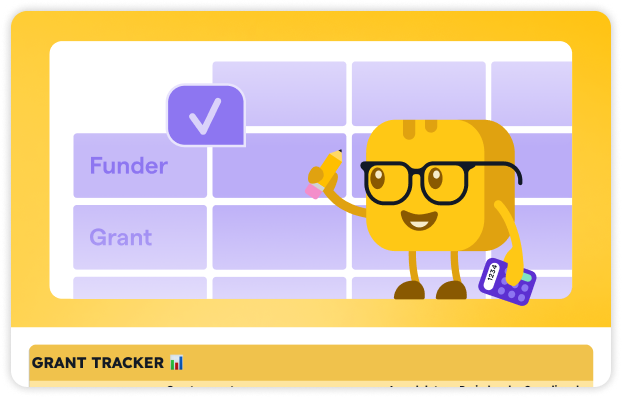
Put these best practices into action with a free grant management template that keeps every active grant and reporting requirement in one place, from award to closeout.
Record award amounts, spending deadlines, report due dates, submission status, and owners, then see which reports are coming due at a glance.
Grant management best practices for small nonprofits
Grant management is demanding for organizations of every size. For a small nonprofit without dedicated grants staff, it can feel like another full-time job squeezed between everything else.
These grant management best practices can help your team stay organized, reduce last-minute scrambles, and manage each award more effectively:
- Keep grant ownership clear 👤 Make sure everyone knows who owns deadlines, documentation, data collection, and funder communication for each grant.
- Create reusable language 📝 Build a shared document with preapproved narrative blocks, such as your mission description, program overview, or theory of change. This can save your team hours during reporting and renewal cycles.
- Hold a grant kickoff meeting 🤝 Bring finance and program staff together within two weeks of receiving an award to review spending restrictions, reporting requirements, and data-collection expectations.
- Choose grants intentionally 🎯 Focusing on fewer, better-aligned opportunities can reduce reporting and compliance demands while giving your team more time to manage each award well.
Build a grant management process your team can sustain
Winning a grant is worth celebrating. Managing that grant well helps turn funding into lasting impact while building the trust that can lead to future support. Start with a clear system: track restricted funds from day one, calendar every deadline, assign clear owners, and keep essential information accessible to your team.
Givebutter isn’t a dedicated grant tracking tool, but the platform can support specific parts of your process. Use Givebutter’s nonprofit CRM to organize funder contacts and donation tracking to record grant payments, including offline payments received by check or wire. Nonprofits can also use DAFpay to accept and view DAF grants. With Givebutter Plus, you can sync transaction data to QuickBooks Online and create reports and data exports to support financial recordkeeping.

Manage funder contacts & grant payments for free
Sign up for Givebutter to keep funder contacts and grant payment records alongside the rest of your fundraising data.
FAQs about grant management for nonprofits
How do you track grant spending?
Assign each restricted grant a unique code, class, or project in your accounting system so every payment and expense can be tied to the correct award. A dedicated spreadsheet may work for a simple grant portfolio, while QuickBooks Online or fund accounting software can help categorize transactions and compare spending against the approved budget.
Regardless of the system you use, keep supporting documentation—such as receipts, invoices, contracts, and payroll records—with every expense.
What happens if you miss a grant reporting deadline?
The consequences depend on the funder and grant agreement. A missed deadline could delay future payments, create compliance issues, or affect your eligibility for renewal.
Contact the program officer as soon as possible, explain the situation, and provide a realistic date for submitting the report. Proactive communication is always better than letting the deadline pass without an update.
Do nonprofits need grant management software?
Not necessarily. A spreadsheet, shared calendar, and accounting system may be enough for a small or straightforward grant portfolio.
Purpose-built grant management software for nonprofits may be worth the investment when your organization has multiple funders, frequent reporting deadlines, complex expense allocations, or several team members involved. The best system is one your team can maintain consistently.
Share this article








.svg)
.svg)