.svg)
.svg)
.svg)
.svg)
.svg)
.svg)
.svg)
.svg)
.svg)


.svg)
.svg)
.svg)
.svg)
.svg)
.svg)
.svg)
.svg)

.svg)
.svg)
.svg)

.svg)

.svg)
.svg)
.svg)
.svg)
.svg)


.svg)
.svg)
.svg)
.svg)
.svg)
.svg)
.svg)




.svg)



%20(1).png)

Two emails land in a donor's inbox. One is a spreadsheet of statistics and program reach. The other shares the story of a person transformed by the organization. The second raises 50% more. Why? Because donors don't give to statistics. They give to people.
According to a Storyraise survey of more than 250 nonprofit donors, over 70% said they’re more likely to donate to a nonprofit that uses storytelling to communicate mission and impact. More than 80% said they’d continue supporting that nonprofit if they received regular story-driven updates.
Your organization already has the stories. This guide gives you a four-part nonprofit storytelling framework to find, frame, and share them in a way that moves donors to act.
Key takeaways
- Lead with people, not data 💛 Donors give to humans, not statistics.
- Use a repeatable four-part framework 🔄 Every nonprofit story needs a Character, Challenge, Intervention, and Transformation.
- Build connection with specificity 🧑 Names, ages, and details make stories feel real.
- Make donors the hero 🦸 Centering your story on the supporter drives greater impact.
- Share stories across channels 🤳 Email, video, social media, campaign pages, and direct mail all reward storytelling.
- Tell your story better with Givebutter 🧈 With campaign pages built for narrative-first fundraising, email tools for personalized story delivery, and a CRM for tracking donor engagement, Givebutter helps nonprofits manage it all in one free platform.
Effective storytelling for nonprofits: The 4-part framework
Nonprofit storytelling uses personal narratives to create a connection between your supporters and your cause. Creating that connection is within reach for any team, regardless of size or budget.
Here's a repeatable four-part framework and set of nonprofit storytelling techniques that anyone on your team can use to tell impactful stories across email, social, events, and direct mail.
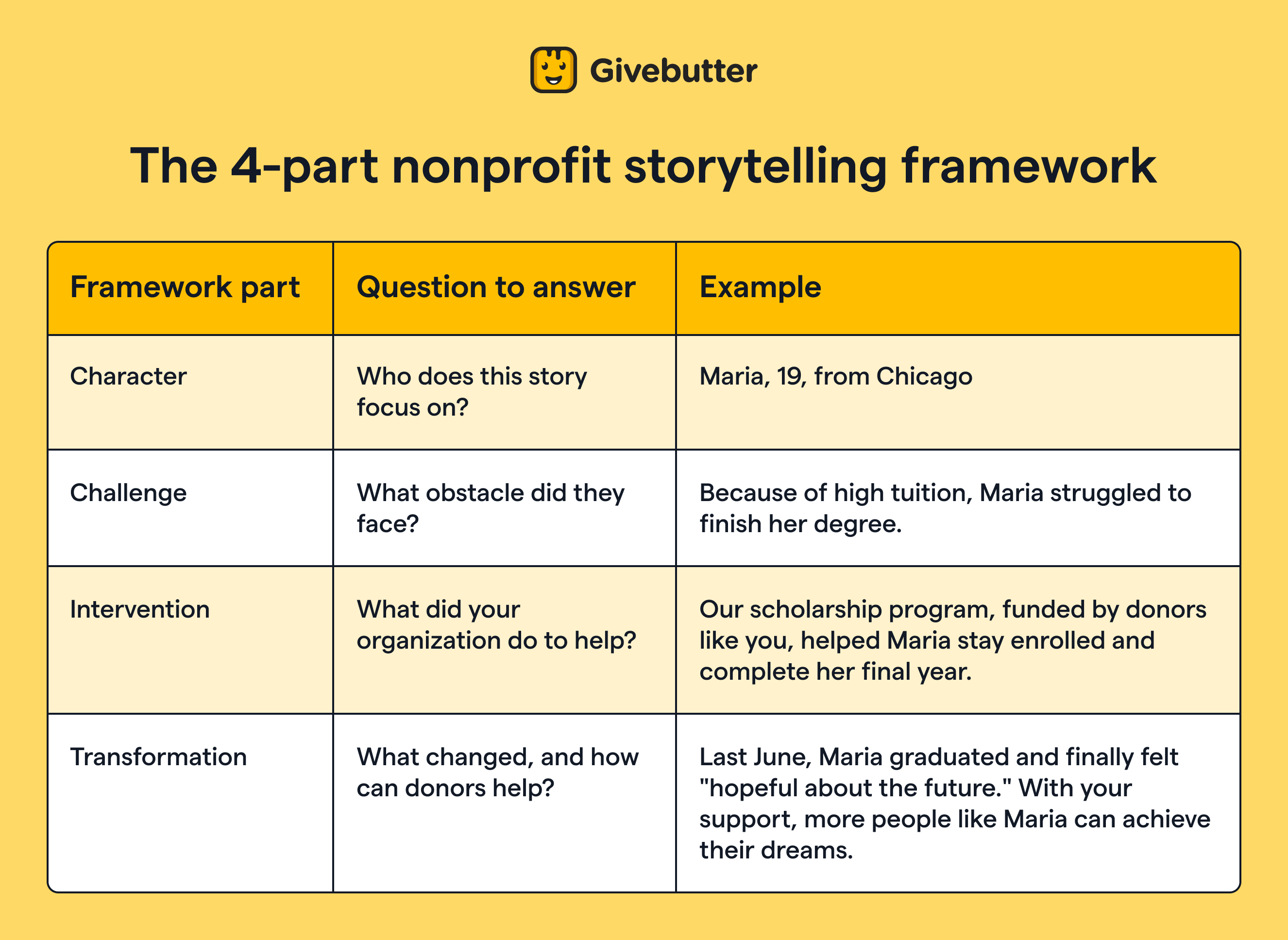
Character 👤
The first step to developing a compelling story about your nonprofit is focusing on one beneficiary of your mission. Details matter. The more specific you are, the more likely supporters are to take action.
Make sure you have written consent to use a beneficiary's real name. Otherwise, change identifying details.
⭐ Example: Maria, 19, from Chicago
Challenge 🚧
Next, you'll want to consider the person's struggle: What obstacle did this person face?
Keep this section focused and brief. The goal isn't to dwell on hardship—it's to help donors understand what's at stake and what their support can change. A sentence or two is enough to set the context before moving into the intervention and transformation.
If you're having trouble pinpointing the challenge, try:
- Focusing on systemic barriers: What broader system or barrier contributed to this challenge? The economy? A housing shortage? A natural disaster?
- Asking the beneficiary to share their own story: Give folks an easy way to share their experiences with you by setting up a call, meeting in person, or using a simple intake form on your website. This both empowers beneficiaries and ensures that the story is accurate.
- Focusing on the facts: Though imagery and vivid language can be compelling, be sure to stick to real, evidence-based challenges.
⭐ Example: Because of high tuition, Maria struggled to finish her degree.
Intervention 🤝
Now consider how your organization and its services helped your beneficiary overcome their challenge. Did you help them find housing? Go back to school?
When crafting the intervention section, be sure to:
- Make donors the hero: Focus the story on the person, not your organization, and how donors can help.
- Be specific: "We provided job training" is a bit too vague and leaves readers feeling disconnected from your story.
⭐ Example: Our scholarship program, funded by donors like you, helped Maria stay enrolled and complete her final year.
Transformation ✨
Close your story by answering one key question: What changed? When done well, readers are left feeling both satisfied and inspired.
To nail this section:
- Balance facts with feelings: Donors want concrete outcomes, but they also want to be emotionally moved.
- Be honest: Supporters value transparency. Be truthful about the change, even if it's incremental.
- Invite donors into the story: End your narrative with an invitation to join in shaping the future of continued impact.
⭐ Example: Last June, Maria graduated and finally felt "hopeful about the future." With your support, more people like Maria can achieve their dreams.
3 nonprofit storytelling examples that move donors
If you're looking for a bit more inspiration before creating your own story, here are three standout campaigns that use the exact framework above to invite supporters to be a part of their journey.
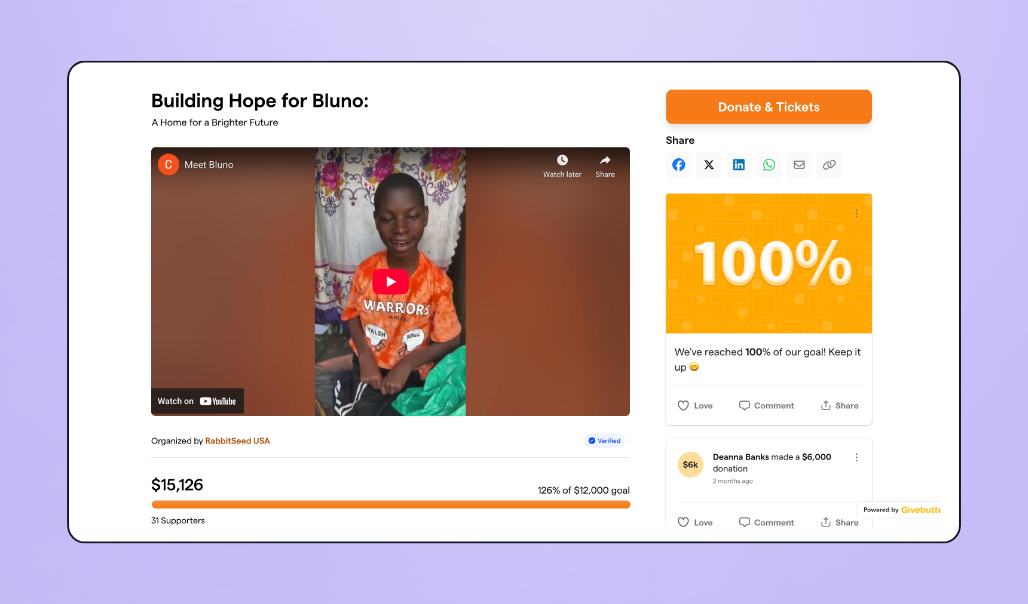
1. Building Hope for Bluno 🧡
RabbitSeed USA partnered with grassroots Ugandan ministries to launch Building Hope for Bluno to fund a custom home for Bluno, a young boy with disabilities, and his family. Instead of leading with the project, the campaign centers on Bluno's daily life, needs, and future.
🎯 Technique: Character-first storytelling
💛 Why it works: The campaign doesn't ask donors to fund housing. It asks them to help Bluno. By anchoring the story on one real person, donors can immediately understand the impact of their gift. The combination of specific details, visuals, and narrative makes the outcome tangible: your donation becomes Bluno's home. That clarity drives emotional connection and action.
2. 2 Before 2 ❤️🩹
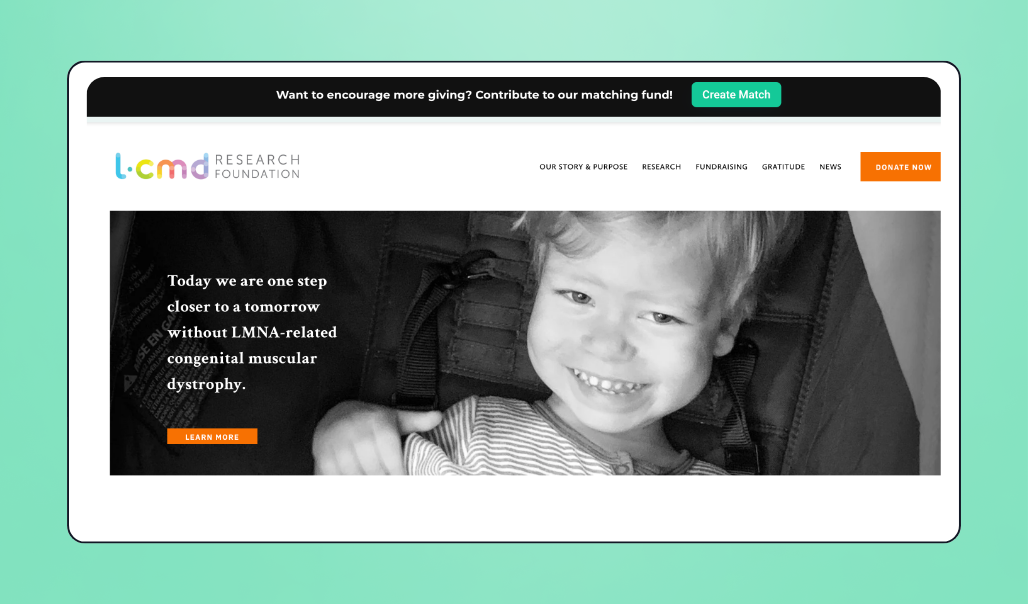
L-CMD Research Foundation launched 2 Before 2, a campaign focused on Austin, a young child with a rare terminal disease. The goal was clear and urgent: raise $2M before his second birthday to fund a gene therapy trial. (Spoiler alert: They exceeded it!)
🎯 Technique: Video-driven storytelling & urgency
💛 Why it works: This campaign pairs a deeply personal story with a concrete, time-bound goal. The video introduces Austin as a real child, while the "2 before 2" framing creates urgency that's easy to understand and rally behind. Donors aren't just giving to research. They're racing against time for Austin.
3. Urgent: Save Charlyn! 🐾
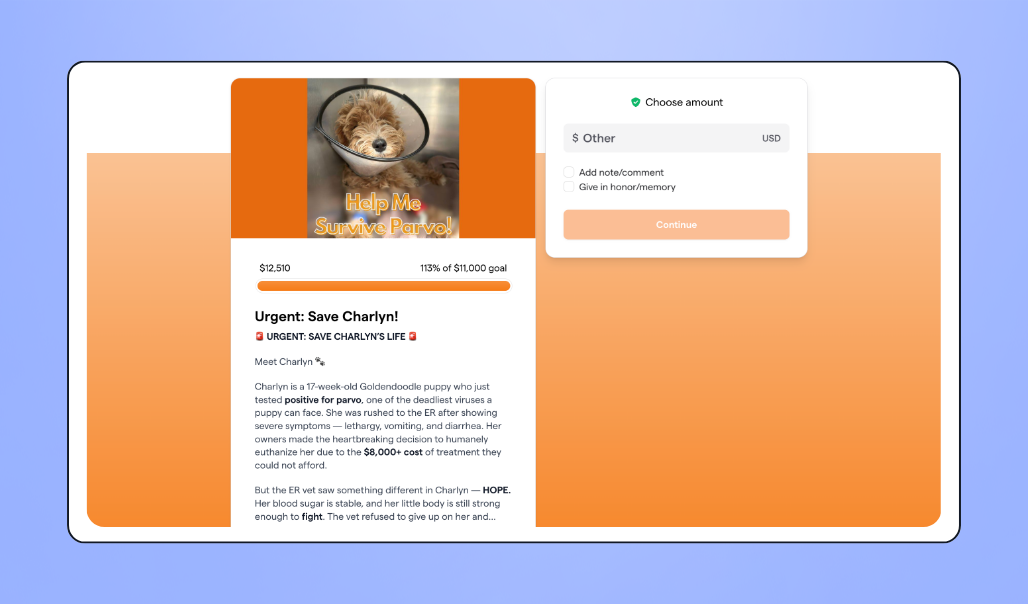
California Doodle Rescue launched Save Charlyn, a campaign to fund life-saving treatment for a 17-week-old puppy diagnosed with parvo. The campaign leads with a direct question: Will you help her get a second chance at life?
🎯 Technique: Donor-as-hero framing & urgent CTA
💛 Why it works: The story is simple, immediate, and emotionally clear. By framing the donor as the one who can save Charlyn, the campaign creates a direct line between action and outcome. The urgency, combined with a clear and achievable goal, lowers friction and makes giving feel both necessary and impactful.
Where & how to share your nonprofit stories
The framework above covers the nonprofit storytelling best practices for what to say. This section covers where to say it.
To make sure your stories reach donors, share them across multiple platforms, from email to social media. Here are the top channels and how to use each one.
Email 📧
Email is one of the highest-ROI storytelling channels for most nonprofits, but only when it feels personal.
When sharing your narrative, be sure to:
- Lead with the story, follow with the ask, and keep the message under 200 words
- Segment your donor list so the right story reaches the right donor (a major donor gets a detailed impact story while a monthly donor gets a quick update)
- Include only one story and one CTA per email so you don't overwhelm donors
Video 🎥
According to research, people retain 95% of a message when they see it in a video, compared to only 10% when reading text. That's why it's essential to leverage this medium wherever you can, from social media to email.
Creating effective nonprofit video storytelling is more accessible than most teams realize. All you need is:
- A phone
- Good lighting
- A genuine story with real people
- Free livestreaming tools
💡 Pro tip: Keep your TikTok and Instagram Reels videos under 30 seconds, and create long-form content for YouTube and Facebook with captions (most people watch without sound).
Campaign pages & peer-to-peer fundraising 🎯
Your fundraising page is often the first place a donor encounters your story, so it needs to be compelling.
To strengthen your page, be sure to:
- Lead with a specific person or moment, not your organization's history
- Include a photo or video above the fold for immediate connection
- Give peer-to-peer fundraisers a customizable story template so they can share why they care about your mission
Social media 📱
The same Storyraise survey found that nearly 70% of donors prefer to receive storytelling content from nonprofits via digital channels, with social media as the top choice.
While each platform rewards a slightly different storytelling format, the principle is the same everywhere: lead with the person, not the organization.
Here's how you can post on each platform:
- Instagram and TikTok: Short video and carousel posts outperform static images.
- Facebook: Longer narrative posts with a photo still drive strong engagement from older donor demographics.
- LinkedIn: Donor impact stories and staff perspective pieces perform well for corporate and major donor audiences.
And with Givebutter's Meta fundraising integration, sharing your campaign link on Facebook or Instagram Stories automatically adds a donate button, your campaign image, and a progress bar—so your story drives action the moment someone sees it.

Direct mail 💌
Direct mail isn't dead. In fact, many major donors and older supporter segments prefer a printed letter with a story and a photo to an email or a social media post.
When crafting your mailings, be sure to:
- Limit the story to one page
- Use a real staff person's signature (Director of Development, Executive Director, etc.)
- Include a specific ask ("Your gift of $250 funds one student's full semester fees")
- Add a QR code linking to a video version for donors who want to learn more
Your website & newsletter 🌐
According to the same Storyraise survey, 15% of donors prefer to receive storytelling content on websites and blogs, and 13% prefer email newsletters. That means your website and newsletters should do more than describe your programs. They should show them in action.
Here's how to do it:
- Website: Create a dedicated impact stories page organized by program area or story type, and update it quarterly.
- Newsletter: Include one story per issue to build anticipation and keep open rates high.
Tell your story with Givebutter
By now, you've learned how powerful nonprofit storytelling can be and how to structure stories that drive donations. The next step is putting that into practice consistently across every channel your donors use.
With Givebutter, you can turn a single story into a complete fundraising experience. Build a fundraising page that leads with your narrative, send personalized emails to the right donor segments, and track how supporters engage with your story over time, all in one place.
Whether you're sharing a quick impact update or launching a major campaign, Givebutter helps you tell better stories, reach more donors, and measure what's working without adding more tools or extra work.
.png)
Take your story further with free marketing tools
Sign up for Givebutter and start building campaigns that connect, inspire, and drive more donations.
FAQs about storytelling for nonprofits
How do small nonprofits tell better stories without a big budget?
The most practical storytelling tips for nonprofits on a tight budget: start with one story per month, use your phone for video (raw footage often outperforms polished production anyway), and repurpose everything across channels. One story can become a social post, an email, a campaign page update, and a direct mail insert without any additional production time.
How do you measure whether nonprofit storytelling is working?
To measure your storytelling efforts, A/B test story emails vs. data emails on open and click rates, track donor retention for story-engaged donors vs. those who aren't, and add one survey question ("What made you decide to give?").
What are the best tools & platforms for nonprofit storytelling?
The best tools and platforms for nonprofit storytelling include video tools (phone camera and free editing apps like CapCut), design tools like Canva, personalized video thank-yous via ThankView, and fundraising and distribution through Givebutter (campaign pages, email, and CRM).
Where can I find nonprofit storytelling workshops & training?
Look for a mix of in-person and online learning resources, including webinars, workshops, and community forums. Givebutter also offers free nonprofit training webinars covering storytelling and fundraising topics, a great starting point for teams on a tight budget.
What is the Nonprofit Storytelling Conference?
The Nonprofit Storytelling Conference is an annual event that teaches nonprofit professionals how to collect, craft, and share stories that move donors to give.
Share this article






.svg)
.svg)