.png)


.svg)
.svg)
.svg)
.svg)
.svg)
.svg)
.svg)
.svg)
.svg)


.svg)
.svg)
.svg)
.svg)
.svg)
.svg)
.svg)
.svg)

.svg)
.svg)
.svg)

.svg)

.svg)
.svg)
.svg)
.svg)
.svg)


.svg)
.svg)
.svg)
.svg)
.svg)
.svg)
.svg)







%20(1).png)
Table of contents
Table of contents
.svg)

Your donors already love Venmo. It's one of the most popular ways to send money, and it makes sense that your nonprofit wants to use it for donations too.
The catch is that Venmo charity profiles have real limitations. Donor data is limited, recurring giving isn't supported, and every transaction comes with a fee that donors can't cover on their end.
Givebutter solves all of that. Donors can still give via Venmo, and you automatically get full donor data, tax receipts, and recurring giving built in.
We'll cover how Venmo charity profiles work, what Venmo charges nonprofits, where the platform falls short, and how to get more out of every Venmo donation.
Key takeaways
- Venmo has real limits 👀 Donor data is thin, tax receipts are basic, and recurring giving isn't supported.
- Skip the personal account 📋 Commingled funds and missing tax receipts create compliance and audit risk.
- Venmo fees add up 💰 Nonprofits pay 1.9% + $0.10 per donation—and donors can't cover it.
- Charity profiles require a PayPal business account 🔗 You'll need to set that up first before you can claim your Venmo charity profile.
- Only 501(c)(3)s qualify ✅ Sports teams, PTOs, and other groups aren't eligible for a Venmo charity profile.
- Givebutter is the free, all-in-one alternative 🧈 Venmo is built in—no separate account needed—plus donor data, tax receipts, recurring giving, and more.
What is Venmo, & how does it work?
Venmo is a peer-to-peer (P2P) mobile payment service that lets users transfer money to others.
Here's how it works:
- Link a payment method 💳 Users connect their bank account, credit card, or debit card to the Venmo app.
- Send and receive payments 💸 Venmo users can request, send, and receive money without re-entering card information each time.
- Withdraw funds 💰 Users can: cash out immediately to their bank account (for a small processing fee), transfer within 1–2 business days for free, or keep funds in Venmo for quick payments.

Can nonprofits use Venmo for donations?
Yes, nonprofits can use Venmo for donations via a Venmo charity profile, which is a separate account type specifically designed for verified 501(c)(3) organizations.
While it might be tempting to use a personal account, doing so could put your nonprofit at risk. Funds commingle with personal finances, and neither nonprofits nor donors receive IRS-compliant tax receipts.
How to set up a Venmo nonprofit account
Setting up a Venmo nonprofit account (also called a charity profile) requires a few steps across both PayPal and Venmo:
Step 1: Set up a PayPal business account 💼
To get started, create a PayPal Business account and select the nonprofit designation. You'll need your EIN, website URL, and bank account details to complete this step.
Make sure that the same person who sets up the PayPal charity account also owns and manages the Venmo account (the names must match).
✍️ Note: a Venmo business account for nonprofits is not the same as a charity profile. You'll want to follow the steps below to set up the correct account type.
Step 2: Create your Venmo charity profile 🔍
Confirm your charity status in your PayPal business account notifications or the PayPal charities dashboard.
Once confirmed, head to the PayPal App Center and search for "Venmo charity profiles." Then, click "Get Started." Your PayPal charity info will automatically transfer to Venmo to begin your charity profile setup.
Finally, review and agree to Venmo's User Agreement and Privacy Statement.
Step 3: Customize & publish 🎨
Add your organization name, description, category, keywords, contact information, and photos. Once published, you'll receive a blue checkmark badge and a unique QR code you can share at events, on social media, and in email.
Venmo nonprofit fees: What does Venmo charge?
Currently, Venmo's nonprofit fees are 1.9% + $0.10 per donation. So, if a supporter sends $100 via Venmo, your nonprofit organization will receive $98 of that donation. It's worth noting that Venmo users who send donations to a charity profile using a credit card will be exempt from the standard 3% Venmo fee on payments funded by credit cards.
Givebutter, on the other hand, is 100% free to use. Enable optional donor tips and your nonprofit pays $0 in platform fees and $0 in processing fees—and the Givebutter Guarantee means if a donor doesn't cover the fee, Givebutter will. You keep every dollar you raise.
What Venmo for nonprofits can't do
Before creating a charity profile or fundraising directly through Venmo, here are a few limitations worth knowing.
❌ Limited donor data: Venmo provides basic donor contact information through account statements, but doesn't offer CRM-style fields, segmentation tools, or the ability to track giving history and manage ongoing donor relationships.
❌ No donation follow-up: Venmo sends a basic receipt but doesn't offer tools to customize acknowledgments, send campaigns, or manage ongoing donor communications.
❌ No recurring giving: Venmo works for one-time donations, but it lacks the functionality to accept recurring gifts.
❌ Compliance & audit risk: Accepting donations through Venmo can create audit and compliance risks, especially if funds are routed through a personal account.
❌ No unlimited bank transfers: Verified Venmo users have weekly limits on bank transfers and instant withdrawals, which can restrict access to funds.
Venmo vs. Givebutter: Side-by-side comparison
Venmo works great for payments. Givebutter takes it further with fundraising tools built specifically for nonprofits.
Givebutter combines Venmo with other payment methods, a powerful nonprofit CRM, and fundraising tools to help you run more effective campaigns and keep more of what you raise.
How nonprofits use Venmo through Givebutter
With 95.4M active Venmo accounts in the US, your donors are already paying this way—here's how to make sure you're ready to accept it.
Step 1: Create your free Givebutter account 🧑💻
Any organization that collects donations, like sports teams, PTOs, or faith groups, can sign up for Givebutter. You don't need a nonprofit Venmo account to get started—Givebutter campaigns automatically have a built-in Venmo payment option, so there's no complicated setup.
Step 2: Launch your fundraiser 🚀
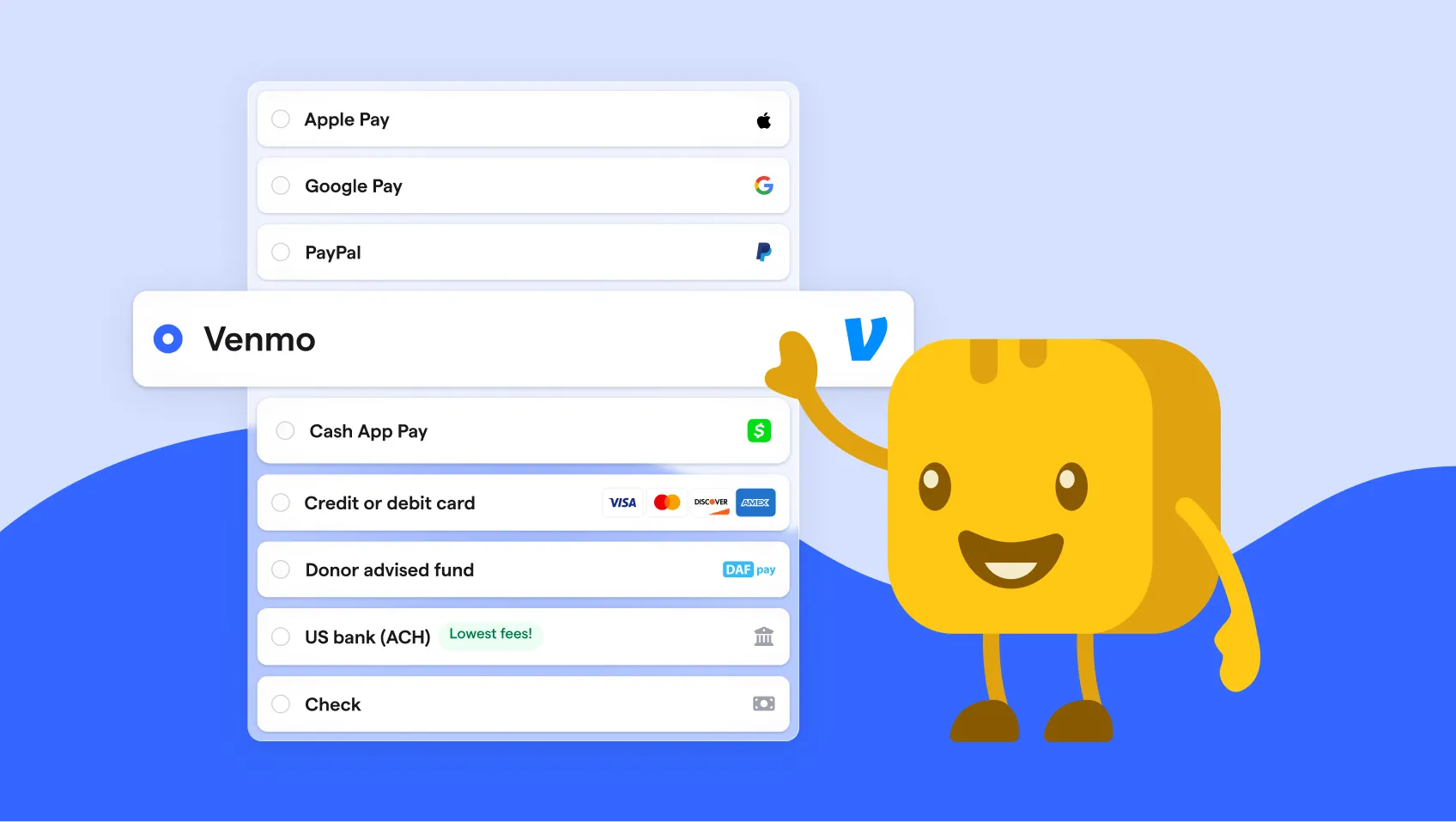
Set up a donation page, campaign, or event in minutes. Venmo will appear as a payment option automatically alongside credit cards, PayPal, Apple Pay, Google Pay, and more. You can also enable recurring donations on any campaign so donors can give monthly, quarterly, or annually—no manual follow-up needed.
Step 3: Accept donations & let Givebutter handle the rest 💸
When a donor gives via Venmo, their information (name, email, address, and giving history) is captured automatically and saved to your CRM. They also receive an immediate, branded tax receipt, and you get a fully updated donor record.
"Givebutter makes it ridiculously easy to set up a campaign and start raising funds fast. The ability to accept Venmo, PayPal, cards, and even offline donations in one place? Chef's kiss." — Michael Ryan W., Club Triangle Flint Founder
Accept Venmo donations the right way with Givebutter
Venmo is already a familiar payment option for many donors, making it a convenient way to increase giving. But accepting Venmo donations doesn't have to mean managing a separate charity profile or piecing together multiple tools.
With Givebutter, Venmo is built in. Donors can give in seconds and receive automatic receipts, while your organization gets a fully updated CRM without extra setup. You can also accept other payment methods, enable recurring donations, and build long-term donor relationships—all in one place.
Accept Venmo donations without the hassle
Sign up for your free Givebutter account today to accept Venmo donations, expand your donor base, and raise more for your mission.
FAQs about Venmo for fundraising
What is the alternative to Venmo for nonprofits?
Givebutter is a free alternative to Venmo built specifically for nonprofit fundraising.
The platform offers donation forms, campaign pages, a nonprofit CRM, automated tax receipts, recurring giving, and multiple payment options, including Venmo, Cash App, PayPal, Apple Pay, and more.
Can I use my personal Venmo for nonprofit fundraising?
Personal Venmo accounts aren't designed for nonprofit fundraising. They don't generate tax receipts, separate personal and organizational funds, or meet compliance requirements.
Using a platform built for charitable giving ensures proper documentation, fund separation, and compliance.
Does Venmo provide tax receipts for nonprofit donations?
Yes, Venmo automatically sends a basic donation receipt to the email address associated with the donor's Venmo account. However, they cannot be customized.
Does Venmo support recurring donations for nonprofits?
No, Venmo does not support recurring donations. Donors must manually initiate every transaction, which means there's no way to set up automatic monthly giving through the platform.
Can sports teams use Venmo to collect donations?
Venmo charity profiles are only available to verified 501(c)(3) organizations, so most sports teams won't qualify for the lower nonprofit fee rate. However, sports teams can still accept Venmo donations through Givebutter for free, without needing a Venmo account. Any organization that collects donations, including sports teams, PTOs, and community groups, can sign up and start accepting Venmo payments at no cost.
33% of Venmo users are between the ages of 18 and 24, and 50% are between 25 and 34, making it a natural payment option for schools, student-led campaigns, and community fundraising groups.
Share this article


Subscribe
150K+ changemakers already subscribed





.webp)


.svg)
.svg)


%201.webp)