.svg)
.svg)
.svg)
.svg)
.svg)
.svg)
.svg)
.svg)
.svg)


.svg)
.svg)
.svg)
.svg)
.svg)
.svg)
.svg)
.svg)

.svg)
.svg)
.svg)

.svg)

.svg)
.svg)
.svg)
.svg)
.svg)


.svg)
.svg)
.svg)
.svg)
.svg)
.svg)
.svg)




.svg)


%20(1).png)

Donor walls have a reputation for collecting dust. But when done well, donor recognition is one of the most reliable ways to retain supporters and deepen giving over time. The 2025 FEP Q4 Report found that giving growth was driven almost entirely by major donors, making tangible acknowledgment more than just a nice touch.
This guide covers 10 creative donor wall ideas for every budget, plus practical design tips, a real nonprofit example, and a free digital option that works for any organization.
Key takeaways
- Pick your format first 🧱 Match your donor wall format to your budget, audience, and capacity to update it.
- Put your donor wall somewhere visible 👀 Place it in a high-traffic area of your building or on your campaign homepage, and mention it in emails, events, and social posts.
- Assign one person to own updates 🔄 Set a clear cadence, and if manual updates keep slipping, switch to a digital format that syncs automatically.
- Make recognition a live moment, not a static list ⚡ Use real-time displays at events, so donors see their name as they give.
- Create your free donor wall with Givebutter 🧈 Givebutter's supporter feed is built into every campaign—free, engaging, and ready to display instantly.
What is a donor wall?
A donor wall is a physical or digital display that publicly recognizes donors by name as a thank-you for their support and a way to celebrate what their giving makes possible. Commonly used by universities, hospitals, museums, and nonprofits of all sizes, they can take many forms: engraved plaques, painted murals, website lists, or real-time digital feeds.
10 donor recognition wall ideas: Physical & digital examples
To help kickstart the planning process, consider these unique donor wall ideas.
1. Classic donor recognition plaques 🪧
Metal plaques offer an affordable, low-lift way to recognize your donors, even with a limited budget or space.
⭐️ Best for: Individual donor recognition, major gift acknowledgment
💰 Cost: Low–medium ($20–$200+ per plaque depending on material and size)
💪 Effort level: Low-Medium
2. Donor wall tree 🌳
A donor tree consists of a trunk (wood or metal) with each "leaf" inscribed with a supporter's name.
⭐️ Best for: Nonprofits with a strong community identity, schools, healthcare organizations, capital campaigns
💰 Cost: Medium–high (custom fabrication runs $500–$5K+)
💪 Effort level: Medium (high upfront installation, but individual leaves can be added over time)
3. Mural or painted donor wall 🎨
You can transform any hallway into a donation wall by adding supporters' names with acrylic lettering or paint.
⭐️ Best for: Organizations with a creative brand, community centers, youth organizations, nonprofits on a tight budget
💰 Cost: Low–Medium (paint and supplies if DIY, or $500–$2K+ for a local muralist)
💪 Effort level: Medium (requires artistic skill or a contractor, and updates may require repainting)
4. Tiered donor recognition board 🏅
A tiered recognition board groups donors by giving level on a single display or across multiple panels. This popular format acts as a subtle nudge for donors to increase their giving over time.
⭐️ Best for: Annual giving programs, membership-based organizations, universities, hospitals
💰 Cost: Medium ($300–$3K+ depending on materials and number of tiers)
💪 Effort level: Medium (straightforward to install, but requires a clear tier structure and periodic updates as donors move between levels)
5. Glass or acrylic panels 🪟
For a donor wall with a little artistic flair, you can etch each donor name into a glass panel.
⭐️ Best for: Modern or upscale spaces such as hospitals, arts organizations, and university buildings
💰 Cost: High (custom etched glass panels typically run $1K–$10K+ depending on size)
💪 Effort level: Medium (professional installation required, corrections are costly)
6. Stainless steel or architectural signage 🏗️
For an industrial aesthetic, consider adding a sleek stainless steel panel with your supporters' names.
⭐️ Best for: Capital campaigns, permanent installations, organizations with a prominent facility or lobby
💰 Cost: High ($2K–$20K+ depending on scale and fabrication)
💪 Effort level: High (custom fabrication, professional installation, difficult and expensive to update)
7. Outdoor donor wall (bricks, pavers, benches) 🧱
A classic and tangible form of recognition that works well when tied to a specific facility or campaign. They're durable and highly visible.
⭐️ Best for: Capital campaigns, memorials, community organizations with a physical campus or gathering space
💰 Cost: High (installation, materials, ongoing engraving)
💪 Effort level: High upfront, lower ongoing
8. Interactive digital donor wall (on-site screen) 📺
A great alternative to reprinting plaques, interactive digital walls are visually engaging and simpler to maintain as donor names or giving tiers change.
⭐️ Best for: Organizations with high foot traffic, such as hospitals, universities, arts venues, and community centers
💰 Cost: Medium–high (screen hardware + software setup)
💪 Effort level: Medium
9. Virtual donor wall (website-based) 💻
Simple and accessible, a virtual donor wall lets you recognize supporters without physical space or tedious manual updates.
⭐️ Best for: All nonprofits, organizations without a physical space
💰 Cost: Low–medium (depending on CRM/website integration)
💪 Effort level: Low
10. Campaign-based donor wall 🎉
Tying recognition to a campaign creates a clear timeline and can feel more meaningful because it's tied to a concrete, shared goal.
⭐️ Best for: Nonprofits running a specific capital campaign, building fund, or major initiative
💰 Cost: Low–medium (often temporary or digital)
💪 Effort level: Low

How to create a donor wall that people notice
Donor walls can be hard to maintain or easy to overlook. But with a little planning, yours can stay fresh, visible, and meaningful. Here are a few tried and true ways to build an effective donor wall.
1. Choose your format 🧱
Start by considering what format best fits your budget, campaign, goals, and donor audience. The ideas above can help you find a direction, and there's no wrong answer as long as it aligns with your organization.
2. Set your recognition structure 🏷️
Decide how you'll structure your recognition. Each approach comes with tradeoffs for maintenance and donor motivation. You might consider:
- Listing donors alphabetically
- Creating giving tiers ("Community Champions," "Founding Givers")
- Recognizing donors by campaign
Keep it simple. Overly complex tier structures are harder to maintain and can feel exclusionary rather than celebratory.
3. Design for visibility 👀
Donor walls can be an investment, so it's essential to create one that people will actually see and engage with. Be sure to:
- Place it somewhere intentional 🪧 Consider a high-traffic area of your building or a prominent spot on your campaign page where visitors naturally go.
- Make it easy to read 🤓 Use readable fonts, clean spacing, and remove unnecessary clutter.
- Add visual interest ✨ Include GIFs, emojis, illustrations, or other design elements in your digital wall to make recognition feel engaging and celebratory.
4. Plan for updates 🔄
Outdated names and incomplete donor lists are among the fastest ways to turn a recognition tool into a source of frustration. Set a clear update cadence (monthly, per campaign, or per major gift) and assign ownership to one person.
If manual updates keep slipping, that might be your signal to move toward a digital format that syncs from your CRM—less work, fewer headaches, happier donors.
5. Make recognition visible—and make it a moment ⚡
Recognition is a key donor relationship touchpoint. But to make it meaningful, you have to bring it to your supporters rather than waiting for them to find it. Showcase your donor wall by:
- Mentioning it in emails 📩 Let donors know when you've added names or made updates. It reinforces that their support matters to your mission.
- Showcasing it at events 🎉 Use Givebutter's live display to highlight donor names in real time, creating genuine momentum and social proof during your fundraiser.
- Sharing it on social media 🤳 Post pictures of newly added names or updates and remind supporters of where they can view the wall.
- Using a supporter feed 👋 Supporter feeds are a simple way to drive engagement and help donors feel like part of your community.
A real donor wall example in action
The 3rd Annual James Gettys Math Madness Competition brought together students, parents, and community members to raise money for James Gettys Elementary PTO. Students competed in math fact challenges, cheered on their class teams, and unlocked rewards together as donations came in.
The goal was $4K. They raised $5K+ from 136 supporters, reaching 133% of their goal.
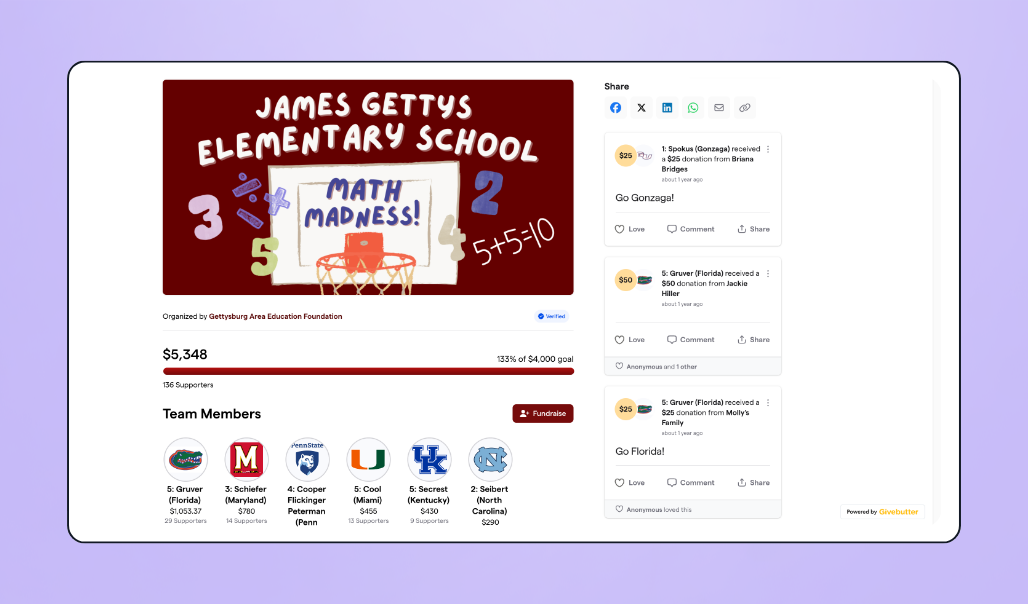
⭐ What worked: The live supporter feed turned every donation into a community moment. Grandparents cheered on grandkids by name. Local businesses like Dairy Queen of Gettysburg showed up with $100 gifts. Parents left notes like "For the extra recess!!!" and "Let's GOOOOOO!" as the campaign hit milestone after milestone. Donors could see each other's names, gifts, and messages in real time, creating a feed that felt less like a transaction and more like a celebration.
Recognize your donors in real time with Givebutter
Whether you choose engraved plaques, a painted mural, or a custom donor wall, physical recognition has a real impact. It's tangible, visible, and meaningful for donors who want to see their name honored.
If you're looking for something more flexible, engaging, and easier to maintain, digital recognition helps keep donors feeling seen without the maintenance headaches.
Givebutter's supporter feed is a free, built-in, interactive donor wall—no setup, no reprinting, no chasing down missing names. Display it at events or on your fundraising page and add personalized thank-you messages. It's donor recognition that stays current, without adding to your team's workload.
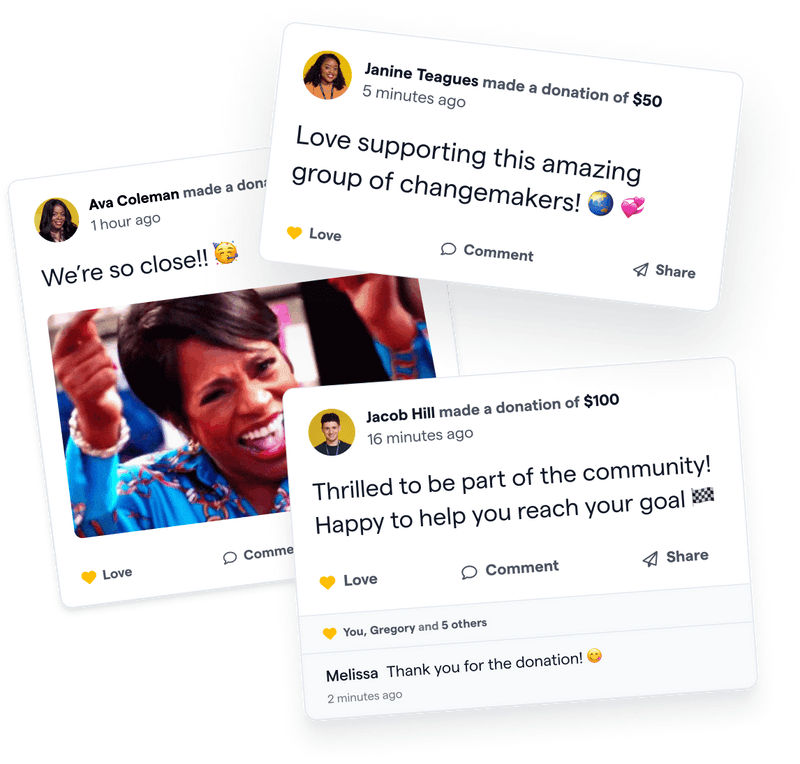
Engage donors in real time with a supporter feed
Create your free Givebutter account and start celebrating your supporters today.
FAQs about donor recognition wall ideas
How much does a donor recognition wall cost?
Here are a few example donor recognition wall costs:
- Physical walls: Engraved plaques, brick, or signage typically range from $1K–$50K+, depending on materials, size, and installation.
- Digital screens/displays: These can cost $0–$5K+ for hardware, plus any software or maintenance.
- Virtual/website walls: Low to no cost, depending on your platform. Givebutter's supporter feed is free and built into every campaign.
Keep in mind that corrections, re-engraving, design updates, and maintenance can add ongoing costs. That's why digital and virtual walls often provide better long-term value.
What is a virtual donor wall?
A virtual donor wall is a digital display that publicly recognizes donors by name. It can live on your campaign page, website, or a dedicated recognition page.
Givebutter's supporter feed functions as a built-in virtual donor wall, making it an easy option for nonprofits without a physical space or online-first campaigns.
What are some donor recognition plaque wording and naming examples?
Here are a few wording and naming examples:
- Dedication: "In honor of [Name]," "In memory of [Name]," "Given by the [Family Name] family"
- Tiers: "Founding Supporters," "Community Champions," "Legacy Givers"
- Appreciation: "Thank You to Our Donors," "Made Possible By"
How to list names on a donor wall?
Most nonprofits default to alphabetical listing for simplicity, but giving tiers can be a useful motivator if your donor base responds well to recognition levels.
How do you keep a donor wall up to date?
Assign ownership to one person and set a clear update cadence (monthly, per campaign, or per major gift). If manual updates start slipping, consider switching to a digital or virtual format like Givebutter's supporter feed.
Are donor walls still effective?
Yes, but the effectiveness depends on how you use them. Walls that get referenced in emails, events, and stewardship efforts drive more engagement than those that sit untouched.
Real-time and digital walls (like Givebutter's supporter feed) help build excitement and momentum throughout a campaign.
Do you need permission to list donors publicly?
Yes, you should always ask permission before publicly listing donor names. Some donors prefer to give anonymously, so include an opt-in checkbox on your donation form and respect those preferences.
Share this article









.svg)
.svg)