


.svg)
.svg)
.svg)
.svg)
.svg)
.svg)
.svg)
.svg)
.svg)
.svg)
.svg)
.svg)
.svg)
.svg)
.svg)
.svg)
.svg)

.svg)
.svg)
.svg)

.svg)

.svg)
.svg)
.svg)
.svg)
.svg)


.svg)
.svg)
.svg)
.svg)
.svg)
.svg)
.svg)







%20(1).png)
Table of contents
Table of contents
.svg)

⚖️ Disclaimer: This content is for general informational purposes only and isn’t legal, tax, or accounting advice. Rules around charitable pledges can vary by state and situation, so for major or complex gifts, it’s best to consult a qualified professional.
Pledge cards are a powerful way to secure long-term, major commitments from donors and create more predictable funding for your organization. But like any fundraising tool, they work best when you know exactly when and how to use them.
This guide walks through everything you need to know about donor pledge cards, from when they make sense to how to design one that's clear and effective. You'll also find practical tips for keeping follow-up simple and admin work light, plus free pledge card templates you can use right away.
By the end, you'll have a practical framework for using pledge cards with confidence.
Key takeaways
- Use pledge cards strategically 🤔 They work best for in-person events and planned commitments, but they add friction to mobile-first campaigns, small one-time gifts, and situations where immediate payment is preferred.
- Design pledge cards intentionally 🎨 Keep them clear, simple, and easy to complete. They should also show donors how their commitment will make an impact.
- Choose the right pledge card for your campaign 🎊 From monthly giving pledge cards to matching donation pledge cards, the right template helps nonprofits collect commitments with less friction.
- Make pledge management easier than ever 🧈 From live event pledges with Givebutter’s paddle raise software to automated reminders and follow-ups, Givebutter makes tracking, managing, and converting pledges smoother than ever.
What is a pledge card?
A pledge card is a written commitment from a donor to give a specific amount of money to your nonprofit over a defined period of time (e.g., $100/month for 36 months).
Unlike a donation form, which facilitates an immediate gift, a pledge card allows a donor to commit now and give at a future date.
When pledge cards make sense (& when they don’t)
While pledge cards can be effective tools for securing gifts and creating clarity, they aren’t the right fit for every scenario. Here’s when they work well, and when they may create unnecessary friction.
When pledge cards are a good fit ✅
- In-person events 🥳 At in-person gatherings, donors are often inspired and ready to give, but they may not have money on hand. Pledge cards capture that enthusiasm as a commitment they can fulfill later.
- Church, school, or community campaigns ⛪ Pledge cards help organizations like these plan budgets and forecast revenue. Physical cards can also be easily distributed at in-person gatherings like Sunday services, masses, or PTA meetings.
- Direct mail appeals and renewals 💌 Pledge cards work well for supporters who prefer mail. They fit neatly into envelopes and are easy to fill out and return.
- Capital campaigns or larger commitments 💸 Multi-year pledge cards break large gifts into manageable payments (e.g., $500/month for five years), making transformational gifts more accessible while providing predictable revenue.
When pledge cards may add friction ❌
- Small, one-time online gifts 🎁 For gifts in the $25–$100 range, a pledge card often slows the process down. Donors who want to make small, immediate gifts shouldn’t have to navigate extra steps.
- Mobile-first campaigns without follow-up systems 🤳 Pledge cards work best alongside automated reminders and fulfillment tracking. Without those systems in place, a digital donation form is often the stronger choice.
- Situations where immediate payment is preferred 🚨 Emergency appeals, matching gift deadlines, and end-of-year fundraising all require fast action, so minimal steps are essential.
Download your free pledge card templates
Pledge card templates offer a simple way to start collecting commitments from your donors.
Designed for clarity and ease of use, these templates can be customized for any nonprofit or purpose, including events, churches, and direct mail campaigns.
When paired with modern follow-up tools like email, CRM tracking, and digital payment options, organizations can reduce delays, streamline data entry, and keep pledges organized in one place.

How to make a pledge card in 5 steps
With your templates in hand, it’s time to customize. Here are the five essential steps to creating a donor-friendly pledge card.
1. Keep the action crystal clear 🧭
Pledge cards work best when they’re straightforward. That means clearly explaining to donors that they’re committing to a gift, not donating right now.
Be sure to:
- Use explicit language ✍️ Avoid saying "donate" when you mean "pledge.”
- Clarify the timeline 📅 Detail when payments are expected to start and when they’ll be completed.
- Explain next steps 🚀 Tell donors what they can expect after committing. Will they receive an invoice? A confirmation email?
2. Limit choices to reduce friction ✂️
One of the most effective ways to encourage pledges is to reduce the number of options. Giving supporters fewer choices reduces confusion, errors, and delayed action.
To simplify the experience:
- Include fewer checkboxes
- Label clear one‑time vs. recurring options
- Remove information unrelated to the pledge
- Use suggested amounts
3. Collect only essential information 🧾
You don’t need to know a lot about your donor to secure a pledge commitment. By requiring just the basics, you’ll increase the likelihood of commitment.
Here are the essential details you need:
- Donor contact info 🏠 Phone number, email, and mailing address.
- Pledge amount and timing 💰 How much the donor plans to give and when they will make payments.
- Preferred payment and follow-up method 💳 Whether they want to give via ACH, Venmo, Google Pay, or another method, and how they prefer to receive follow-up (email, text, phone).
4. Design for fast, error-free completion ✍️
A clean, well-labeled design makes pledge cards faster and easier to complete, which means more commitments and fewer follow-up questions. Here's what to focus on:
- Clear labels, large text, white space 🎨 Label every field explicitly, ensure your font is readable across multiple screen sizes, and leave enough breathing room between sections.
- Checkboxes over free text where possible ✔️ Checkboxes for payment schedule, suggested amounts, and payment methods reduce errors and make the card faster and easier to complete.
5. Anchor the pledge to impact ❤️
As with any donation, donors want to understand how their commitment will make a difference.
To do that:
- Create a short impact line tied to the campaign 🌍 Include one concrete sentence that shows what their pledge accomplishes, such as: "Your $1.2K pledge provides a full year of after-school tutoring for one student."
- Use an encouraging, low-pressure tone 👋 Frame pledges as invitations to create lasting change. For example: "Thank you for considering a pledge. Your support makes our work possible."

9 pledge card examples in action
Below are nine sample pledge cards to help you find the right template for your campaign, goals, and audience.
1. General pledge card 😀
A general pledge card is a flexible option for year-round fundraising campaigns, direct mail appeals, or any situation where you need a versatile pledge form that isn't tied to a specific event or deadline.
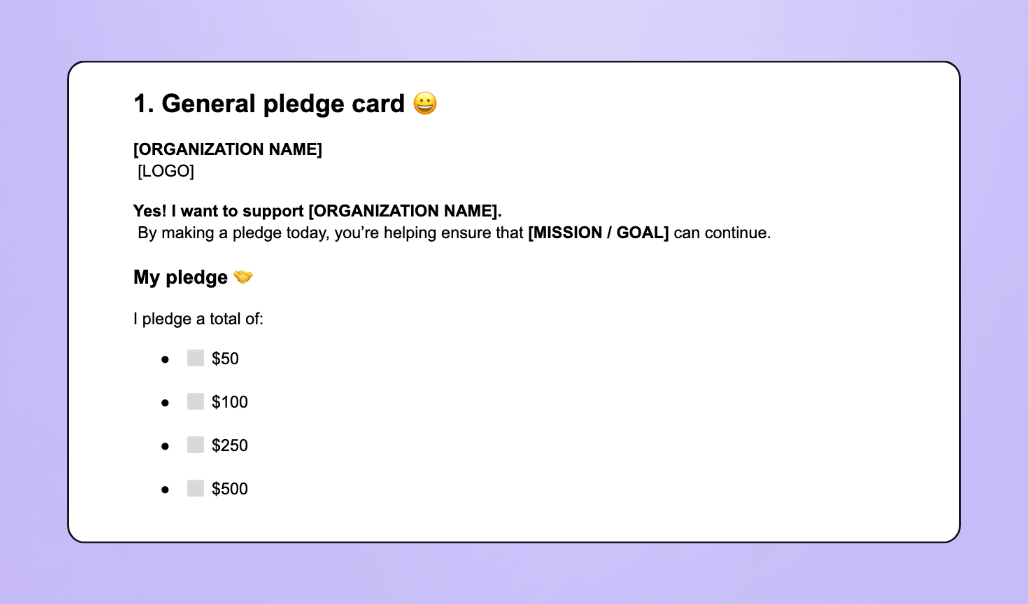
⭐ Best for: Small to mid-sized nonprofits that want one reusable template to use for multiple campaigns throughout the year without creating new forms for each appeal.
2. Event pledge card 🎥
For nonprofits running in-person events like galas, walkathons, or golf tournaments, this template helps capitalize on the day's excitement and momentum.
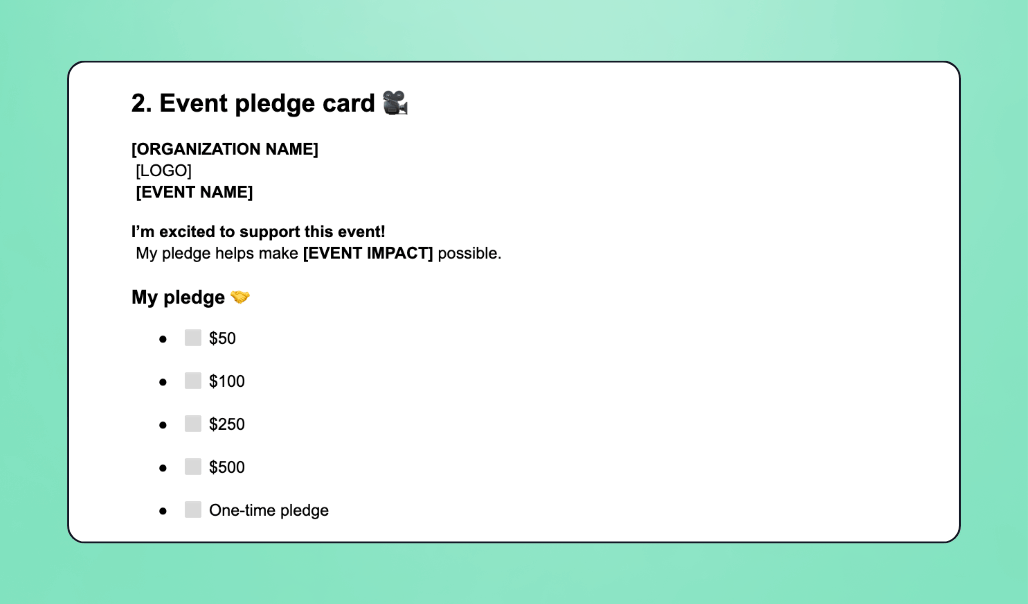
⭐ Best for: Organizations hosting fundraising events that want to capture pledges while energy is high and before donors leave.
💡 Pro tip: While paper pledge cards work well at events, digital or hybrid options are better at converting donors. Givebutter’s paddle raise software allows nonprofits to track live event pledges in real time—digitally and on paper—without missing a single commitment.
3. Capital campaign pledge card 💰
This capital campaign donation card template is designed to collect larger commitments tied to a specific project or goal. With space for project vision, timeline, and impact, it helps donors clearly understand how their pledge supports the broader campaign.
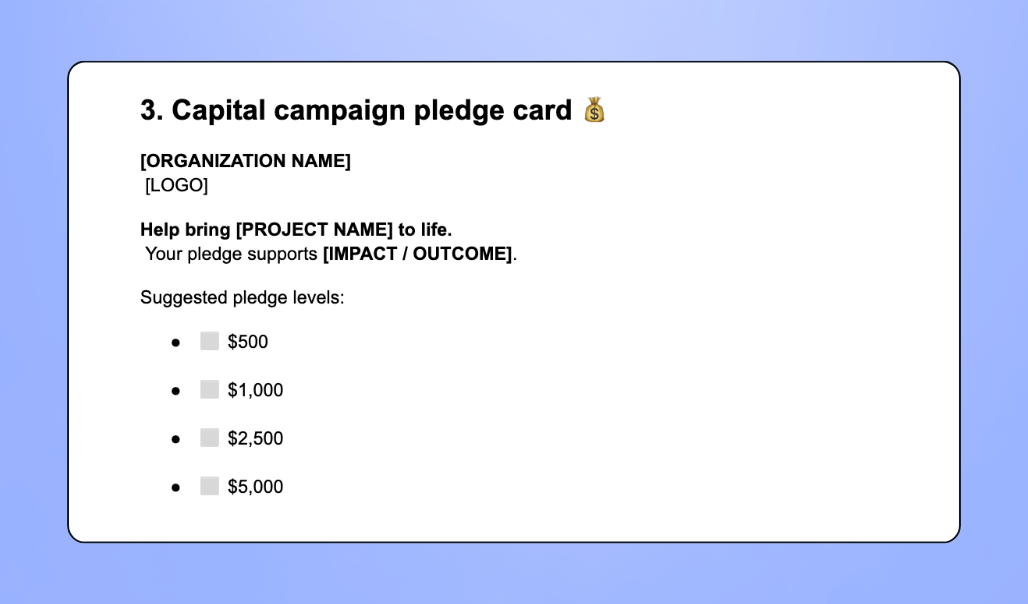
⭐ Best for: Nonprofits running large campaigns with specific funding goals, timelines, and project milestones
4. Church pledge card ⛪
Pledge cards for churches support predictable, ongoing support for ministry and operations. They often include faith-based language around stewardship and options for weekly, monthly, or annual commitments.
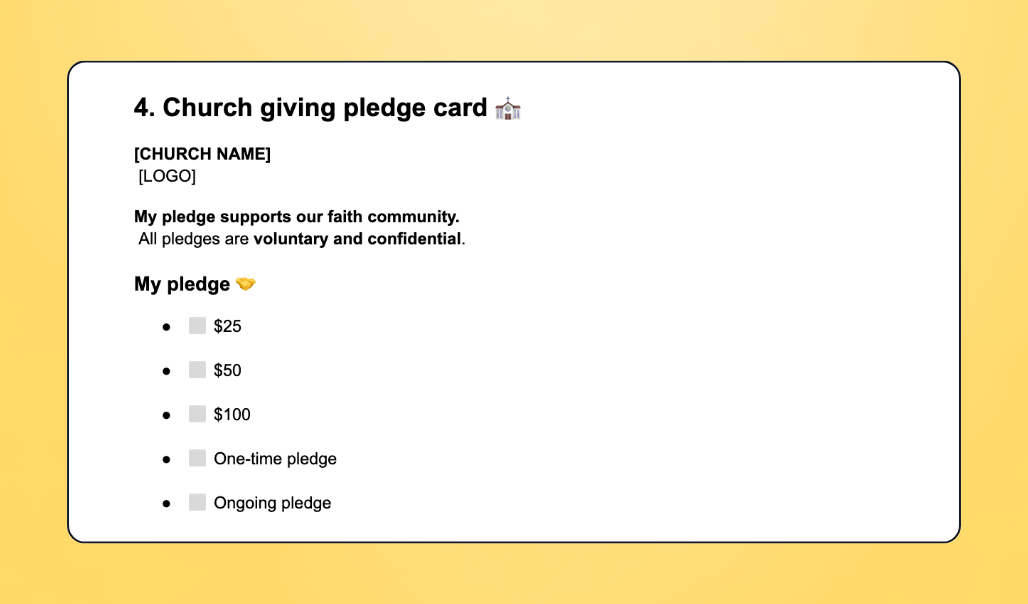
⭐ Best for: Houses of worship and faith-based organizations seeking commitments from congregation members for ongoing ministry support

5. Monthly giving pledge card 📅
This monthly donation pledge card template clarifies recurring commitment while highlighting exclusive benefits or recognition for monthly givers.
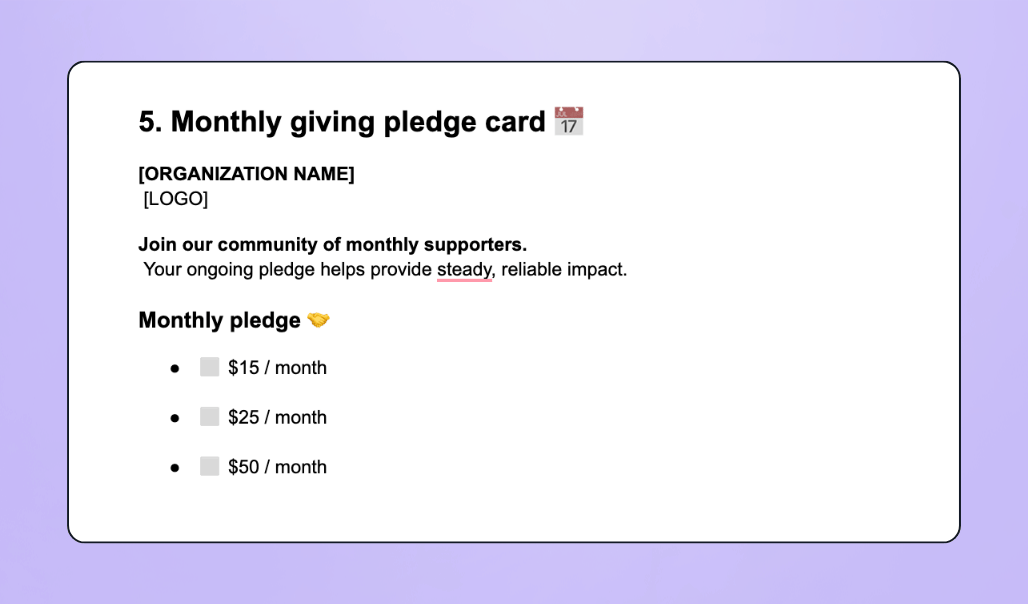
⭐ Best for: Organizations prioritizing donor retention and sustainable revenue
6. Annual appeal pledge card 🎉
Ideal for building on momentum after a successful year, this pledge card example frames giving as part of an annual tradition of support and shared progress.
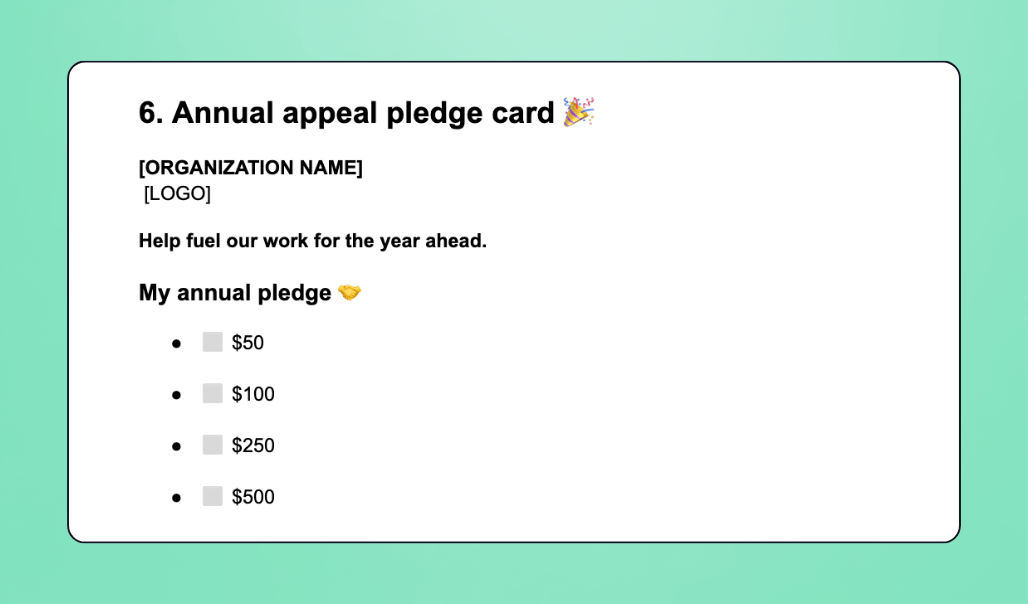
⭐ Best for: Nonprofits that want to secure annual commitments during year-end or anniversary campaigns
7. Company sponsorship pledge card 💼
Designed for corporate partnerships and event sponsorships, this pledge card helps secure multi-level commitments with clear sponsorship tiers and benefits.
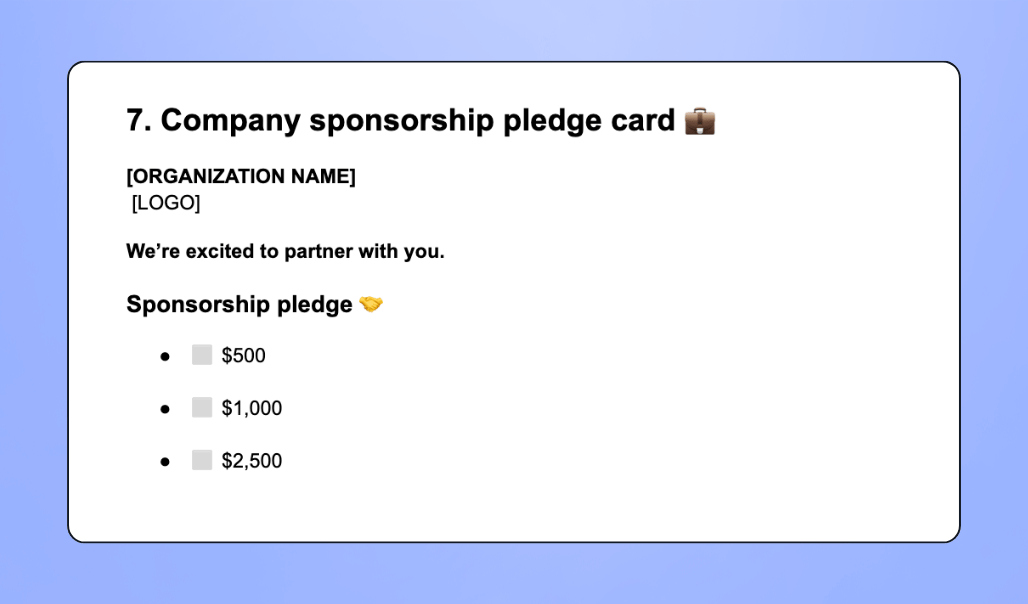
⭐ Best for: Nonprofits seeking corporate sponsors for events, programs, or general operating support
8. Matching donation pledge card 🤝
This card captures key details like the total match amount, payment preferences, and timeline. Personalize it to make matching donations seamless, ensuring every dollar raised goes further for your cause.
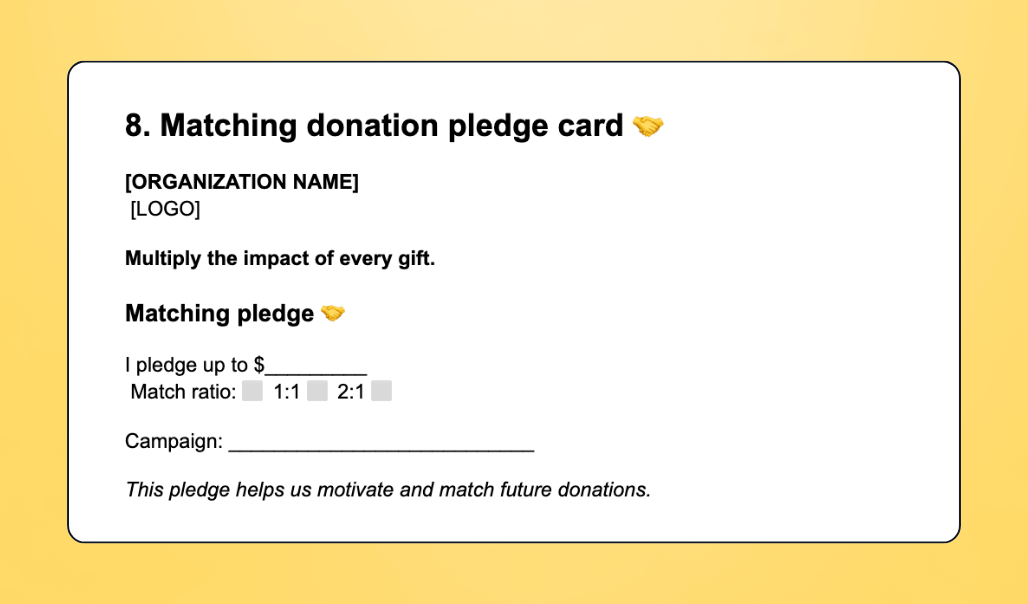
⭐ Best for: Organizations running matching gift campaigns who need to formalize the matching donor's commitment
9. Item donation pledge card 🎫
Use this pledge card sample to secure commitments for physical items and ensure you have strong prizes lined up for your next campaign, event, or auction.
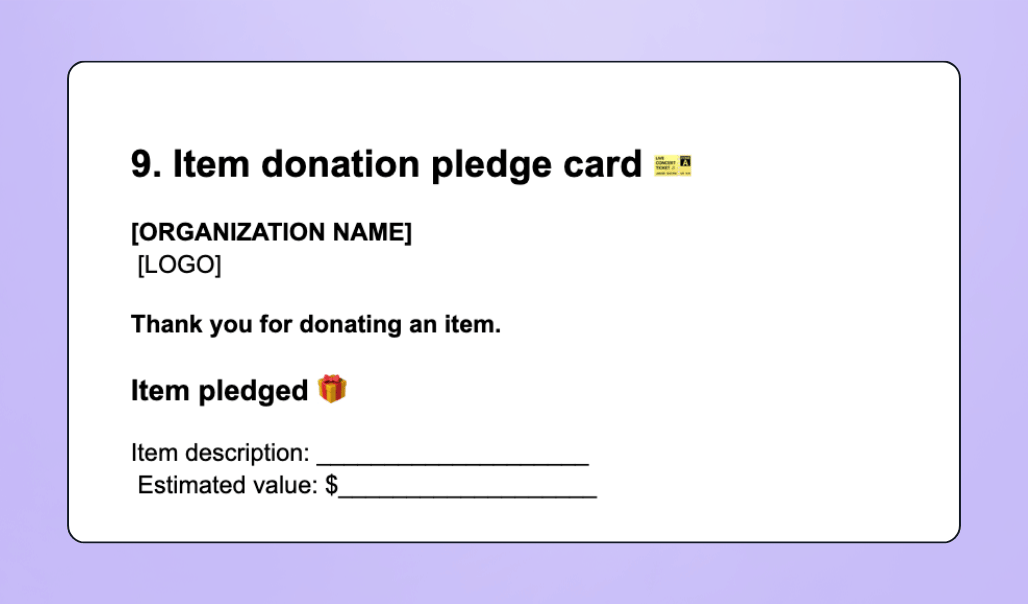
⭐ Best for: Organizations hosting auctions or events that depend on donated items
Manage pledges the easy way with Givebutter
Pledge cards give supporters a flexible way to commit to giving over time, making them especially useful for major gifts, campaigns, and long-term fundraising goals. When handled well, they help nonprofits plan ahead, steward donors thoughtfully, and build stronger relationships.
The key is having a system that keeps everything organized.
Givebutter makes it easy to track pledges, send automated reminders, accept multiple payment methods, and manage donor relationships in one place. With built-in fundraising tools and a robust CRM, nonprofits can stay on top of commitments and remain aligned with their goals.

Easily track & fulfill pledge donations with Givebutter
Sign up for Givebutter today and start turning pledges into completed donations.
FAQs about donation pledge cards
What size should a pledge card be?
Pledge cards can be postcard size, business card size, or digital. The best option depends on how and where you plan to use them.
Should pledge cards include payment details?
Yes, they should include details such as payment method (check, credit card, ACH/bank transfer), payment schedule (one-time, monthly, quarterly, annually), total pledge amount, and installment amounts.
Are pledge cards legally binding?
Pledge cards are generally not legally binding. However, enforceability can depend on the language used, the circumstances, and local laws.
Should pledge cards be paper, digital, or both?
Pledge cards can be paper, digital, or both. Digital options tend to be more efficient, as they reduce delays, improve data accuracy, and simplify pledge tracking.
For nonprofits that want to use digital pledge cards, Givebutter’s paddle raise software lets teams track live event pledges in real time—digitally and on paper—without missing a single commitment.
Share this article


Subscribe
150K+ changemakers already subscribed


_4x%20(1).webp)





.svg)
.svg)


%201.webp)