


.svg)
.svg)
.svg)
.svg)
.svg)
.svg)
.svg)
.svg)
.svg)
.svg)
.svg)
.svg)
.svg)
.svg)
.svg)
.svg)
.svg)

.svg)
.svg)
.svg)

.svg)

.svg)
.svg)
.svg)
.svg)
.svg)


.svg)
.svg)
.svg)
.svg)
.svg)
.svg)
.svg)







%20(1).png)
Table of contents
Table of contents
.svg)

⚖️ Disclaimer: This content is for general informational purposes only and does not constitute legal, tax, or accounting advice. Rules around charitable pledges and donations vary by state and by situation, so nonprofits should consult qualified professionals for major, complex, or legally sensitive gifts.
Pledges can unlock larger commitments and long-term support. But knowing when to ask for a pledge versus a one-time or recurring donation isn’t always clear.
You might be weighing risk versus reliability or wondering how pledges work behind the scenes. Are they enforceable? How should they be reported? And what happens if a commitment is never fulfilled?
Below, we break down how pledges and donations really compare, when each option makes the most sense, and how to manage pledges with clarity and confidence. If pledges fit your strategy, you’ll also find a free, ready-to-use pledge reminder template to help you follow up smoothly and professionally.
Key takeaways
- Pledges vs. donations: Know the difference 🤔 Each affects cash flow, reporting, and donor relationships in distinct ways.
- Pledges shine in the right situations 💛 Major gifts, capital campaigns, and matching opportunities are where pledges tend to perform best.
- Recurring donations are often the simpler choice 🔄 For smaller gifts and steady cash flow, automated recurring donations beat manual pledge tracking.
- Set guardrails before you fundraise ✅ Clear policies, honest reporting, and thoughtful follow-up make pledges easier to manage.
- Givebutter handles both 🧈 Track pledges, manage fulfilled gifts, and steward donors all in one free platform.
The difference between a pledge & a donation
The distinction between a pledge and a donation matters more than it may seem. While both support your mission, they affect cash flow, reporting, donor relationships, and planning in different ways. Understanding how each one works helps you choose the right ask at the right time.
What a donation is (money in hand)
Donations are immediate, completed gifts where the donor has already given up control of the funds. Unlike pledges, donations are typically straightforward, with funds deposited into your bank account immediately.
Here’s what that looks like:
- Process 🤔 Individuals, groups, businesses, or organizations decide to make a donation based on their values, interests, or desire to support a specific cause.
- Form and amount 💰 Donations can take many forms, including monetary gifts and in-kind contributions.

What a pledge is (a promise, not cash)
Unlike an immediate donation, a pledge is a commitment to give at a later date. They can be multi‑year or tied to events, sponsorships, or capital campaigns.
Pledges typically fall into one of two categories: conditional (fulfillment depends on specific requirements) and unconditional (fulfillment is not contingent on any requirements).
Pledges generally involve:
- Promise to contribute 🤝 An individual or organization commits to contribute a specified amount of money or form of assistance in support of a particular cause or initiative.
- Documentation 📄 Pledges are often documented in writing through formal pledge agreements, contracts, pledge cards, or less formal written commitments.
- Fulfillment of pledge ✅ The donor fulfills the commitment by making the agreed-upon contributions, such as money, goods, or services.
When pledges make sense for nonprofits
Pledges can be enticing for nonprofits, especially for major and multi-year initiatives, but they aren’t always the right choice. Compared to donations, they work best when paired with the right systems and a clear internal process.
Here are a few situations where collecting pledges makes sense:
- Capital campaigns and major projects 💰 For large projects such as a building expansion, pledges provide an accessible entry point for donors to participate without giving a large lump sum.
- Budget planning and predictable revenue 📈 Pledges can help forecast future funding, as long as you account for the fact that they aren’t cash in hand.
- Major donor cultivation 👥 High-net-worth donors may give through appreciated stock or annual bonuses, making long-term pledges a practical vehicle for their giving.
- Matching campaigns 🎊 Major donors often pledge to match funds, multiplying small donations and driving urgency and participation.
Pledges vs. recurring donations: A better alternative for many nonprofits
While pledges play a key role in major gifts and large campaigns, recurring donations are often simpler to manage, more trustworthy revenue indicators, and better suited for short‑term cash flow, goals, and grant optics.
Situations where donations are a better fit
- When you need sustainable, predictable revenue 🔄 Unlike pledges, a monthly giving program can automatically collect gifts without complex invoicing or follow-up, providing reliable cash flow.
- When you’re engaging a younger audience 🧒 Many younger donors want to "set it and forget it," making automated donations more appealing than manual pledge payments.
- When a donor wants to give smaller amounts 🎁 If a supporter isn’t a major donor but wants to give consistently, recurring donations allow them to make a significant impact over time.
- When grant optics matter 👀 Heavy reliance on multi‑year pledge campaigns can inflate early revenue and leave later years looking weaker when the pledges run out, which is not ideal for grant applications.
Common problems nonprofits face with pledges
Pledges work best when your team is set up to manage them well. Here's what to plan for so you can accept them with confidence.
- Pledge fulfillment can vary 📅 Donor circumstances change, and not every commitment will be fulfilled on the original timeline. That's why tracking systems and proactive follow-up matter—so your team stays informed and can respond with care.
- Heavy administrative burden 🗂️ Recording commitments, scheduling invoices, tracking payments, reconciling accounts, and sending missed payment reminders can take up significant staff time without the right tools.
- Cash flow requires careful planning 💸 Because pledges are commitments rather than money in hand, it's important to forecast conservatively and pair pledge revenue with a strong recurring giving program for steady cash flow.
- Reporting and recognition require clear systems 📊 Many nonprofits benefit from establishing clear internal guidelines around when to record pledges as revenue and how to communicate pledge status in donor-facing materials.
💡 Pro tip: Tools like Givebutter’s paddle raise software help nonprofits record pledges in real time, digitally and on paper, so no commitments are missed and follow-up can happen faster while donor intent is still high.
If you decide to accept pledges, set these guardrails
Clear policies make the pledge process smoother for your team and your donors, and the steps below will help you get there.
Set internal rules before you fundraise ✅
Because pledges add complexity, it’s essential to align your team on how to handle them internally and in donor-facing communications. To do that, you’ll want to establish:
- A written pledge policy 📃 Outline what counts as a pledge, any minimum pledge requirements, how pledges are tracked and organized, and who will manage them. Clear internal rules prevent confusion among staff, board members, auditors, and donors.
- A budget 🧮 Decide how pledges will be recorded in your budget, including when funds can be counted and when they can be spent.
- A payment schedule 🗓️ Determine when donors are expected to make payments (monthly, quarterly, or annually), and whether to include grace periods or reminders.
- An internal pledge team 🤝 Decide who on your staff will manage pledges, including tracking payments, handling follow-ups, and maintaining communication.
Be honest in reporting & communication 📊
Clear reporting guidelines help everyone stay aligned, from your internal team to your board, auditors, and donors. Here's how to make pledge reporting straightforward and transparent.
- Distinguish pledges from cash 💸 In regular communications or in larger documents like annual reports, clearly differentiate pledges from funds already received. For example: "We've secured $1M in pledges, with $300K collected to date," rather than "We raised $1M."
- Be upfront with donors 👋 Explicitly state your expectations around payment timelines, and keep donors informed about their remaining pledge balance and the impact they’re helping create.
Follow up with care (not pressure) 💛
Thoughtful, well-timed follow-ups strengthen donor relationships and build trust. A warm, appreciative tone goes a long way, especially when reaching out about upcoming or missed payments.
- Make reminders friendly and appreciative 🙏 When reaching out about upcoming or missed payments, keep a grateful tone and assume good intent.
- Create a graduated follow-up system ⏱️ Use automated reminders, such as 10 days before the due date, on the due date, and 15 days past due.
- Make it easy to modify or cancel ❌ Allow donors to adjust pledge amounts or payment terms. It's better to offer flexibility than risk the relationship.
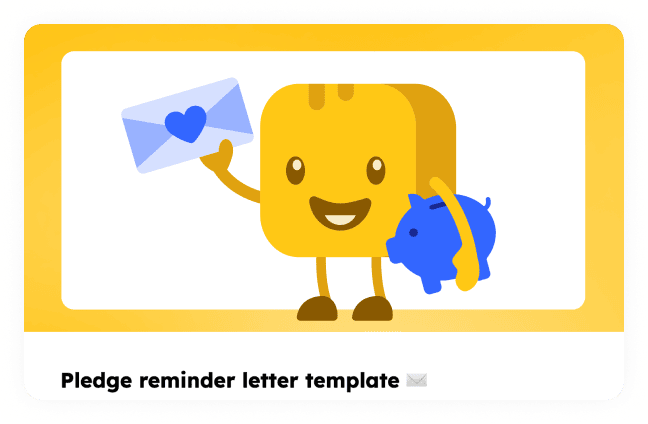
Download your free pledge reminder letter template
A well-timed reminder can make all the difference between a pledge fulfilled and one that quietly slips away. This free pledge reminder letter template takes the guesswork out of follow-up, with language that's warm, professional, and easy to customize for email or direct mail.
Use it to reach out when a payment is coming up, past due, or when you simply want to reconnect a donor with the impact their commitment is making.
Accept both pledges & donations with Givebutter
Pledges and donations each play an important role in nonprofit fundraising. Pledges can unlock larger, long-term commitments and help with planning, while donations provide immediate funds and steady cash flow. The key is knowing when each makes sense and having systems in place to manage them responsibly.
When you’re ready to support both, the right tools make all the difference.
Givebutter helps nonprofits track pledges alongside fulfilled gifts, manage payments, and follow up with donors. With a free CRM, built-in pledge tracking, automated communication tools, and flexible payment options, everything stays organized in one place.
That means less manual work, more transparent reporting, and a smoother giving experience for both your team and your donors, no matter how supporters choose to give.

Log, track, & accept every pledged donation for free
Sign up for your Givebutter account and get started in minutes. It’s free.
FAQs about the difference between pledges & donations
Is a pledge legally binding?
Pledges can be legally binding depending on the terms, conditions, and circumstances. That said, nonprofits rarely pursue legal action over unfulfilled pledges and instead focus on stewardship and follow-up communication.
Should small nonprofits accept pledges?
Yes, small nonprofits should accept pledges as long as they have the right tracking systems, clear policies, and follow-up procedures in place.
With Givebutter, small nonprofits can accept pledges, track payments, and steward donors automatically in one place, for free.
How should pledges be reported to boards or auditors?
When reporting pledges to your board or auditors, be sure to separate pledges from cash received. Break down timelines, fulfillment rates, and outstanding balances. You should also distinguish between conditional pledges and unconditional pledges and document how you record and handle each type.
Share this article


Subscribe
150K+ changemakers already subscribed



_4x%20(1).webp)





.svg)
.svg)


%201.webp)