












The end-of-year giving season is one of the most popular times for donors to give, and one of the biggest opportunities for your nonprofit to raise funds. But with so many moving pieces and deadlines, it’s easy to feel overwhelmed.
While most small nonprofits treat year-end giving as a two-week sprint, the best results often come from starting in October.
We’ve put together a step-by-step guide to building a structured year-end giving campaign that can help you make your busy season your most impactful one.
Key takeaways
- Start in October 🗓️ Nonprofits received 37% of their 2025 online revenue in December, so plan your campaign from October 1 through December 31.
- Set your goal 🎯 Pick a dollar goal tied to an outcome, show it with a goal bar, and secure a matching gift before Giving Tuesday.
- Segment your donors 💸 Tailor November outreach to major donors, recurring supporters, new donors, lapsed donors, and board members leading up to Giving Tuesday.
- Plan seven emails 📧 Send three emails through Giving Tuesday and four in December, leaning on the December 31 tax deadline in your final reminders.
- Invite recurring gifts 🔁 Year-end is a natural time to add a monthly giving option and suggested monthly amounts to your donation form.
- Thank donors in January 💌 On January 1, send personalized summaries, impact reports, and tax receipts to set up the coming year.
- Simplify year-end giving with Givebutter 🧈 Build free fundraising pages, send emails with the drag-and-drop editor, and offer recurring giving, all in one platform.
What is year-end giving?
Year-end giving is the concentrated fundraising push nonprofits make in Q4, from October 1 through December 31. It’s driven by the December 31 tax-deduction deadline, holiday generosity, and employer matching-gift season, which all peak at the same time.
For most nonprofits, it’s the biggest fundraising window of the year. It usually includes a dedicated campaign page, a multi-touch email and text sequence, Giving Tuesday outreach, and a final push in the last week of December, when many donors make their last gifts of the year.
A strong year-end giving campaign does more than bring in one-time gifts. It’s also the best time to thank donors for the year, share your impact, and invite supporters to become recurring monthly donors who keep giving long after December 31.
Why year-end giving is important for nonprofits
Q4 is the most important fundraising season of the year, and there’s a good reason for that.
At the end of the year, donors are motivated by:
- Impact: Donors want to know their gift makes a difference, and year-end is a natural time to show what your nonprofit accomplished and what’s still needed.
- December 31 tax-deduction deadline: Gifts made by December 31 count toward that tax year for donors who claim a charitable deduction, which gives them a built-in reason to give before the year ends.
- Employer matching: Many companies run matching gift programs based on the calendar year, so employees often need to use their benefits by year-end for their gifts to qualify.
All of these motivations led to some pretty big numbers for nonprofits in recent years:
- Giving Tuesday: The day brought in $4.0B in donations in the US alone.
- December: Nonprofits received 37% of their 2025 online revenue in the final month of the year.
- Last week of the year: According to M+R, donations this week accounted for 10% of annual online revenue.
- Last day of the year: December 31 brought in nearly 3x more revenue than Giving Tuesday in 2024.
⚖️ Disclaimer: This article is for informational purposes only and doesn’t constitute legal or tax advice. Tax rules can change and depend on each donor’s situation, so consult a qualified tax professional or the IRS for guidance specific to your organization.

Year-end giving timeline: When to start & what to do
Your year-end giving campaign will run at full speed from Giving Tuesday through December 31, but every strong finish starts with a solid plan. Here’s how to structure your timeline for maximum results.
October: Set up & prepare 🏗️
During this month, nonprofits usually have a bit more time for intentional, strategic campaign planning rather than a two-week sprint during the holidays. The strongest year-end fundraising campaigns start with this groundwork.
Here’s what you’ll want to accomplish to set the foundation for the rest of your campaign:

November: Build momentum 🔥
November is the month to build momentum by using Giving Tuesday (December 1, 2026) as a catalyst for the rest of the year.
To make this phase effective, sort your donors into groups and tailor your outreach to each segment. Consider sending three emails between early November and Giving Tuesday: a soft kickoff email, a mid-campaign update, and a Giving Tuesday message on December 1.
Here’s the strategy for each segment:
💡 Pro tip: Offer a recurring giving option at year-end, while giving momentum is high and the donor relationship is fresh. Add a monthly option and suggested monthly amounts to your donation form, both free on Givebutter.
December: Drive urgency ⚡
As the month begins and Giving Tuesday passes, keep the momentum going with updates, reminders, and special opportunities to give. Here’s what your December outreach timeline could look like:
January: Wrap up & say thanks 💌
On January 1, lay the groundwork for the coming year by sending personalized summaries with donation totals, impact reports, and tax receipts. Update your board members, staff, and partners on outcomes and express gratitude via email, phone, or social posts. With Givebutter Plus, you can also send personal video messages to thank your top donors.
3 end-of-year giving campaign ideas & examples you can learn from
Check out these three real end-of-year giving campaign examples from nonprofits and why donors love them.
1. House of Ruth 🏠
House of Ruth, a nonprofit that provides housing and supportive services for women, children, and families experiencing trauma, raised $625.5K for program support during its year-end campaign.
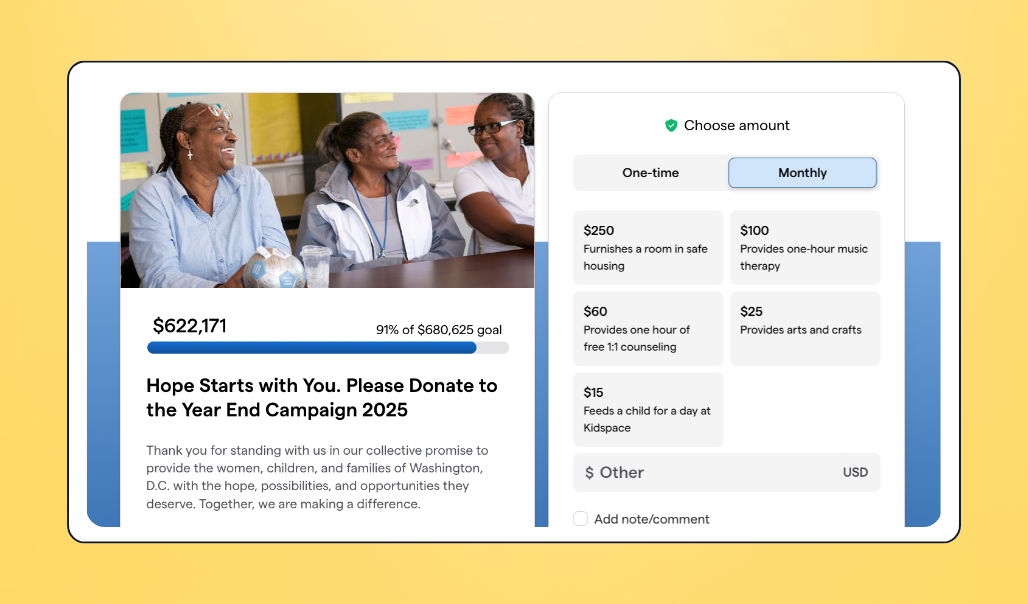
✨ What made it work: A specific narrative connected each gift to an outcome and gave donors a reason to stay engaged throughout the campaign.
📋 What nonprofits can learn: Consistent, story-driven outreach across the full campaign window can keep donors engaged and connected.
2. The James P. Harrington Organization 🏆
The James P. Harrington Organization delivers alternative holistic programs and resources to its community. Its end-of-year campaign raised $64.2K, 213% of its $30K goal, and is a stellar example of how the right goals can take any size nonprofit to new heights.
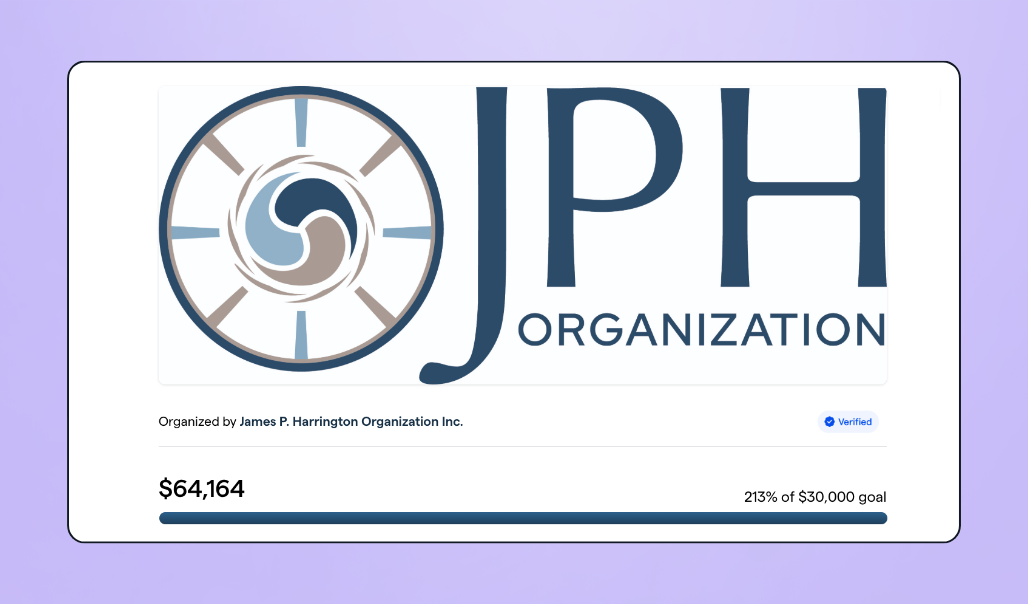
✨ What made it work: Setting a specific, achievable goal, then exceeding it visibly, creates momentum. When donors see a campaign surpassing 100%, they want to be part of the final push.
📋 What nonprofits can learn: You don’t need a six-figure goal to run a high-performing year-end campaign. A focused effort with clear messaging can dramatically outperform expectations at any budget size.
3. Foster Love Bell County 🎁
Foster Love Bell County provides resources from hygiene essentials to emotional support to help children feel seen, valued, and safe. Its 12 Days of Impact campaign raised $64.1K, 213% of its $30K goal, and motivated supporters to stay engaged and give more than once.
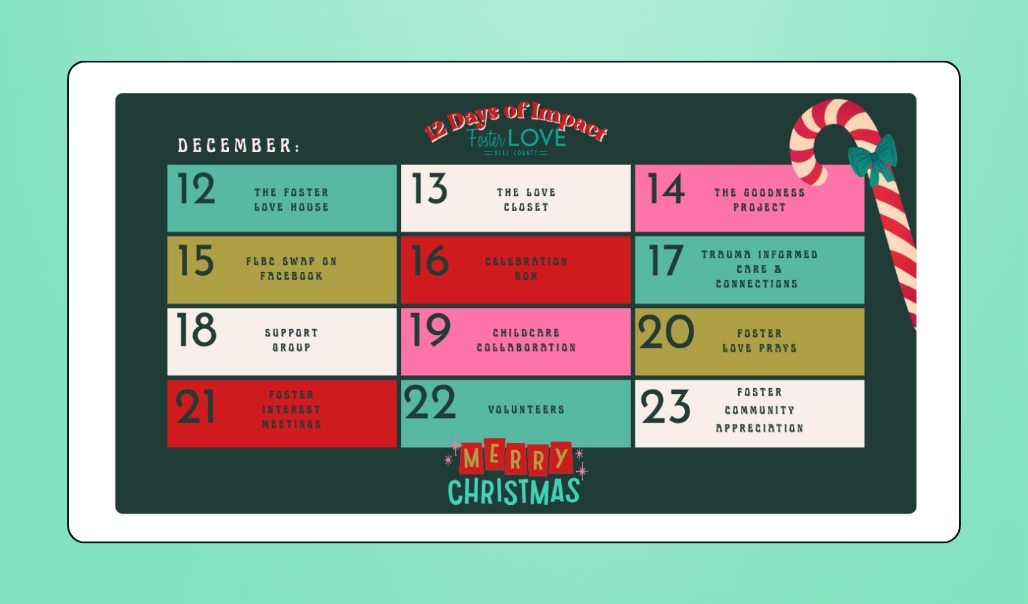
✨ What made it work: The countdown format gave donors a reason to check back daily and work toward the campaign goal.
📋 What nonprofits can learn: A creative campaign mechanic (countdown, matching days, 12-day theme) gives donors a reason to engage repeatedly.

Your best year-end giving season is still ahead
Year-end giving can feel overwhelming, with so many moving pieces and deadlines packed into a few short months. With the right framework and timeline, though, any nonprofit can run a structured, multi-touch campaign that raises real money, converts donors to recurring supporters, and builds momentum for the new year.
If you take one step this week, set a specific dollar goal and add it to your campaign page with a visible goal bar. From there, map out your emails for November and December, and line up a matching gift before Giving Tuesday.
Givebutter brings it all together, with free fundraising pages and donation forms, a drag-and-drop email editor, P2P fundraising tools, recurring giving options, and a nonprofit CRM to keep track of every supporter.

Launch your year-end fundraising campaign for free
Create your free Givebutter account today and launch your most successful year-end campaign yet.
FAQs about year-end giving
When should nonprofits start their year-end giving campaign?
Starting a year-end giving campaign in October allows nonprofits to build their fundraising page, draft their full email sequence, and lock in matching gift commitments.
What is a realistic year-end fundraising goal?
The amount a nonprofit can raise through year-end fundraising depends on factors like its size, audience, and resources.
The key is to set a specific, realistic goal based on your organization’s past performance, current needs, and capacity. From there, consider tactics like adding a goal bar to your campaign page to build urgency and engagement.
How many emails should I send for a year-end campaign?
Send seven emails for your year-end campaign: three between early November and Giving Tuesday (December 1, 2026), and four more before the year ends. Save the final two for December 31, the tax-deduction deadline, when many donors make their last gifts of the year.
- Early November: Send a soft kickoff email.
- Before Giving Tuesday: Send a mid-campaign update.
- December 1: Send your Giving Tuesday message.
- Early to mid-December: Send your first December email.
- December 23 to 30: Send one more email.
- December 31: Send your final two emails.
What is the difference between Giving Tuesday and a year-end campaign?
Giving Tuesday is a single global day of giving. A year-end giving campaign typically spans several weeks, ideally from October 1 through December 31. For most nonprofits, Giving Tuesday is a momentum-builder that leads into the rest of end-of-year giving.
Share this article